GDPR Compliant Employee Monitoring Checklist
Employee monitoring can help businesses understand work activity, improve productivity, protect company systems, and identify security risks. However, monitoring employees also involves collecting personal data, which means businesses must take privacy and data protection seriously.
A GDPR compliant employee monitoring approach is not simply about installing monitoring software and tracking everything employees do. It is about finding the right balance between business requirements and employee privacy.
The General Data Protection Regulation (GDPR) requires organisations to process personal data lawfully, fairly and transparently. Depending on the organisation and the nature of monitoring, businesses may also need to consider data minimisation, storage limits, security measures, employee rights and other requirements.
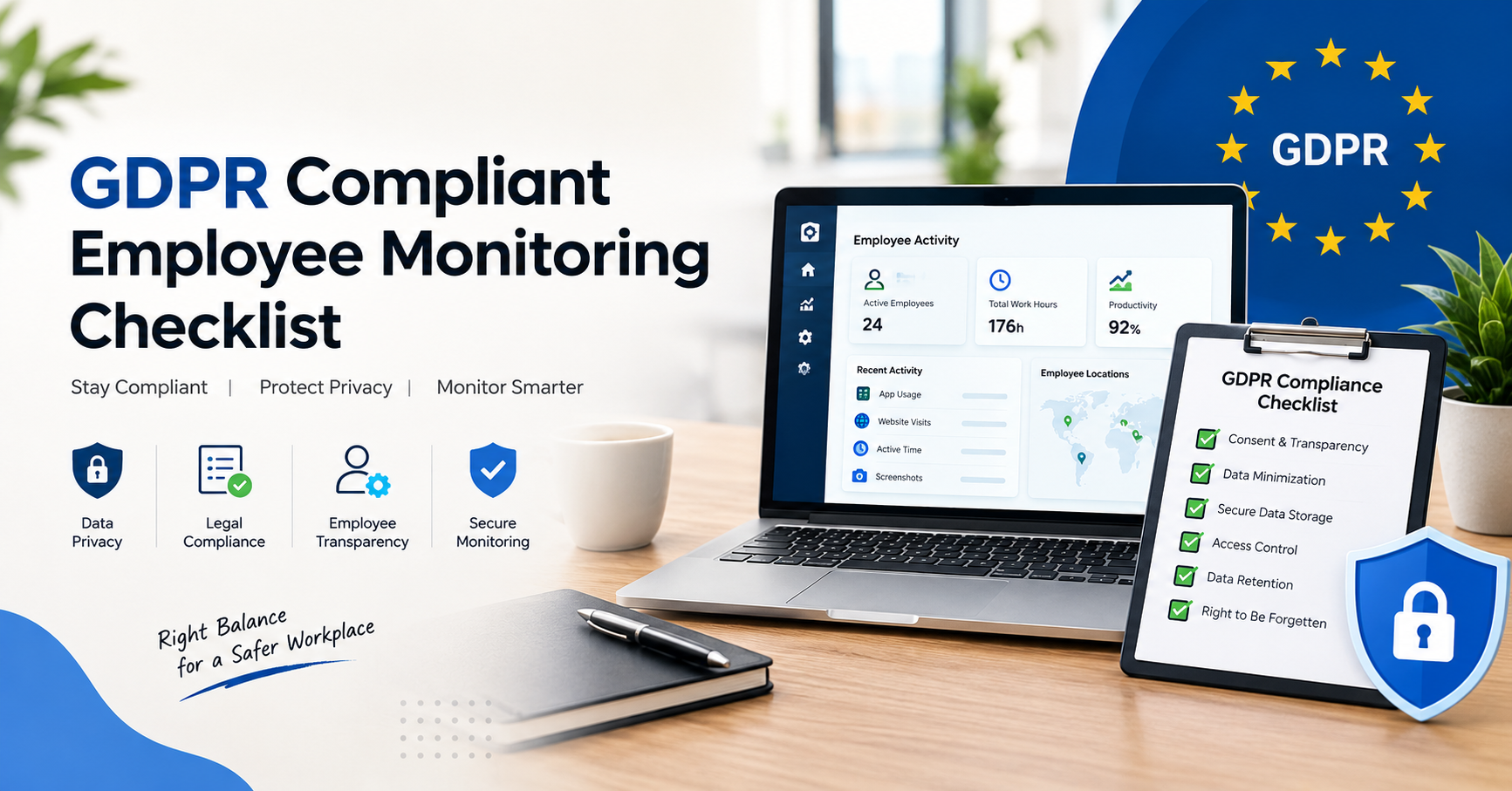
This GDPR compliant employee monitoring checklist explains the major points businesses should review before implementing employee monitoring software.
What Is GDPR Compliant Employee Monitoring?
GDPR compliant employee monitoring means monitoring employee activity in a way that respects data protection requirements and employees' privacy rights.
Employee monitoring may involve information such as:
Working hours
Application usage
Website activity
Computer activity
Login and logout information
Screenshots
Location data
Productivity-related information
Many of these types of information can qualify as personal data when they relate to an identifiable employee.
Therefore, organisations should not collect employee information simply because technology makes it possible. Every monitoring activity should have a clear and legitimate purpose.
GDPR Employee Monitoring Checklist
Use the following checklist to evaluate whether your employee monitoring process follows important GDPR principles.
1. Define a Clear Purpose for Monitoring
Before collecting employee data, clearly define why the monitoring is necessary.
For example, a company may monitor certain activity to:
Protect company systems
Detect security threats
Track working time
Manage company devices
Investigate suspected misuse
Improve operational processes
The purpose should be specific rather than simply stating that the company wants to "monitor employees."
GDPR principles require organisations to use personal data for specified purposes and avoid collecting information unnecessarily.
Checklist:
☐ Is the purpose clearly documented?
☐ Is employee monitoring necessary for that purpose?
☐ Are you avoiding unnecessary monitoring?
2. Establish a Lawful Basis
One of the most important parts of employee monitoring GDPR compliance is identifying an appropriate legal basis for processing personal data.
Depending on the situation, an organisation may rely on a lawful basis such as legitimate interests or a legal obligation. However, the appropriate basis depends on the specific circumstances.
For example, the European Commission notes that an organisation may have a legitimate interest in monitoring employees' IT-device use for network security, but the organisation should choose the least intrusive approach and consider applicable national employment laws.
Checklist:
☐ Have you identified the lawful basis?
☐ Is the processing necessary?
☐ Have you considered whether a less intrusive method is available?
☐ Have you checked applicable employment and data protection rules?
3. Inform Employees About Monitoring
Transparency is a major part of GDPR compliant employee monitoring.
Employees should understand what information is being collected, why it is being collected, how it will be used, and how long it will be retained.
Privacy information should generally explain matters such as:
Who is processing the data
Why the data is being processed
What categories of data are collected
The legal basis for processing
How long the information will be stored
Relevant employee rights
The European Commission specifically identifies these types of information as part of the information organisations should provide to individuals whose personal data is processed.
Checklist:
☐ Is there an employee monitoring/privacy policy?
☐ Are employees informed before monitoring begins?
☐ Is the policy written in clear language?
☐ Does the policy explain what data is collected?
4. Collect Only Necessary Data
A common mistake with employee monitoring software is collecting more information than the organisation actually needs.
GDPR includes the principle of data minimisation, meaning organisations should process only the personal data that is necessary for their stated purpose.
For example, if a company only needs working-time information, continuously collecting detailed screenshots may be excessive depending on the circumstances.
Better approach:
Business requirement → Minimum necessary data → Limited access → Secure storage
This approach helps businesses implement employee monitoring while reducing unnecessary privacy risks.
Checklist:
☐ Are you collecting only necessary employee data?
☐ Can any monitoring feature be disabled?
☐ Are intrusive features genuinely required?
☐ Is there a less invasive alternative?
5. Protect Employee Data
Security is another essential part of GDPR employee monitoring.
Employee monitoring data can contain sensitive business information and personal information. If the information is exposed to unauthorised people, it can create privacy and security risks.
Businesses should therefore use appropriate technical and organisational security measures.
Important controls may include:
Strong authentication
Access controls
Encryption where appropriate
Secure storage
Role-based permissions
Regular security reviews
Monitoring administrator access
Secure data transfers
The EDPB recommends appropriate technical and organisational measures to protect personal data and highlights the importance of awareness and documented procedures for people handling personal information.
Checklist:
☐ Is monitoring data stored securely?
☐ Who can access the information?
☐ Are administrator permissions restricted?
☐ Are security procedures documented?
6. Set a Data Retention Period
Keeping employee monitoring data forever is not a good privacy practice.
Organisations should determine how long monitoring information actually needs to be stored and establish appropriate deletion or review periods.
GDPR's storage limitation principle requires personal data not to be kept longer than necessary for the purpose for which it was collected.
For example, a company could define different retention periods for different categories of information instead of storing every record indefinitely.
Checklist:
☐ Is there a defined retention period?
☐ Is old monitoring data automatically deleted where appropriate?
☐ Are retention periods reviewed regularly?
☐ Is data kept only as long as necessary?
7. Give Employees Appropriate Privacy Rights
Employees are also data subjects under GDPR when their personal information is processed.
Depending on the circumstances, employees may have rights relating to access, correction, deletion, restriction or objection to processing.
Businesses should therefore have a process for handling employee data requests.
Checklist:
☐ Can employees understand what personal data is being processed?
☐ Is there a process for handling privacy requests?
☐ Can inaccurate information be corrected?
☐ Are employee rights explained in the privacy policy?
8. Be Careful With Screenshots and Continuous Monitoring
Screenshots and continuous activity monitoring can be particularly intrusive.
A screenshot may capture:
Personal information
Customer information
Emails
Confidential documents
Passwords or credentials
Private communications
Sensitive business information
Therefore, businesses should carefully evaluate whether screenshots are necessary and whether their frequency and scope are proportionate to the intended purpose.
Systematic workplace monitoring can also raise the need for a Data Protection Impact Assessment (DPIA), depending on the processing and risk involved. EDPB materials identify systematic workplace monitoring among examples of processing that may require a DPIA.
Checklist:
☐ Are screenshots genuinely necessary?
☐ Is screenshot frequency reasonable?
☐ Can sensitive information be protected?
☐ Has privacy risk been assessed?
9. Review Automated Decisions and Productivity Scores
Modern employee monitoring platforms may generate productivity scores, activity scores or automated insights.
Businesses should be careful about using these scores as the sole basis for significant employment decisions.
GDPR contains specific rules concerning solely automated decision-making and profiling where decisions have legal or similarly significant effects. Appropriate safeguards may be required in applicable situations.
A productivity score should therefore be treated as information that may require human review rather than automatically assuming that a lower score means an employee is underperforming.
Checklist:
☐ Are productivity scores reviewed by humans?
☐ Are employees given appropriate explanations?
☐ Are automated decisions assessed for privacy and fairness risks?
☐ Could inaccurate data affect an employee unfairly?
10. Check Whether a DPIA Is Needed
A Data Protection Impact Assessment (DPIA) helps organisations identify and reduce privacy risks before high-risk processing begins.
Employee monitoring can involve systematic processing of personal data, so organisations should assess whether their planned monitoring creates a high risk to employees' rights and freedoms.
If the processing is likely to result in a high risk, a DPIA may be required under GDPR.
Checklist:
☐ Have you assessed the privacy risks?
☐ Have you considered whether a DPIA is required?
☐ Have you documented the assessment?
☐ Have you introduced measures to reduce identified risks?
11. Choose Employee Monitoring Software Carefully
Not every employee monitoring platform provides the same privacy controls.
When selecting monitoring software, businesses should look beyond the number of features and evaluate how the software handles employee information.
Look for features such as:
Role-based access
Data retention controls
Privacy settings
Secure data storage
Access logs
Configurable monitoring
Data export and deletion capabilities
Clear documentation
Security controls
The goal is not to monitor everything. The goal is to monitor only what is necessary for a legitimate business purpose.
12. Review Your Monitoring Policy Regularly
GDPR compliance is not a one-time activity.
Businesses should periodically review:
What data is being collected
Why it is being collected
Who has access
How long it is stored
Whether monitoring is still necessary
Whether new monitoring features have been introduced
Whether privacy risks have changed
The GDPR's accountability principle means organisations should be able to demonstrate compliance with data protection principles.
GDPR Compliant Employee Monitoring Checklist: Quick Summary
Here is a simple checklist businesses can use:
| GDPR Monitoring Check | Status |
|---|---|
| Define a clear monitoring purpose | ☐ |
| Identify the appropriate lawful basis | ☐ |
| Inform employees about monitoring | ☐ |
| Collect only necessary data | ☐ |
| Protect monitoring information | ☐ |
| Restrict access to authorised users | ☐ |
| Set appropriate data retention periods | ☐ |
| Respect employee privacy rights | ☐ |
| Review screenshot/continuous monitoring | ☐ |
| Assess automated decision-making risks | ☐ |
| Determine whether a DPIA is required | ☐ |
| Review monitoring policies regularly | ☐ |
How Employee Monitoring Can Be More Privacy-Friendly
The best approach to employee monitoring is to focus on purpose, necessity and transparency.
Instead of collecting every possible activity record, organisations should first identify the business problem they want to solve.
For example:
Business Problem: Protect company systems.
Possible Solution: Monitor security-related activity and restrict access to sensitive systems.
Avoid: Collecting unnecessary information about every aspect of an employee's activity.
This type of approach supports a more balanced employee monitoring strategy.
Why GDPR Compliance Matters for Employee Monitoring
Employee monitoring involves a sensitive balance between organisational interests and individual privacy.
Poorly designed monitoring can create legal, security and employee-trust risks. In contrast, a transparent and proportionate approach can help organisations achieve legitimate business goals while respecting employee privacy.
The EDPB's published enforcement information also includes a 2025 national case involving employee surveillance through monitoring software, demonstrating that workplace monitoring is an area where data protection compliance can have real enforcement consequences.
Businesses should therefore treat GDPR compliance as an important part of their employee monitoring strategy rather than an optional feature.
Final Thoughts
A GDPR compliant employee monitoring strategy should be based on transparency, necessity, security and respect for employee rights.
Before implementing monitoring software, businesses should define a clear purpose, establish an appropriate lawful basis, inform employees, minimise the data collected, secure the information and establish suitable retention periods.
Most importantly, employee monitoring should not mean monitoring everything.
The better approach is to collect the right information for the right purpose, protect that information properly, and regularly review whether the monitoring remains necessary.