Workforce Productivity Statistics India 2026: Productive India
India’s workplace is changing rapidly as businesses increasingly adopt remote work, hybrid work, flexible schedules, and digital workforce management tools. These changes are influencing how companies measure performance, manage employees, and improve workforce productivity.
In 2026, workforce productivity is no longer measured only by the number of hours employees spend at their desks. Businesses are increasingly focusing on work outcomes, task completion, employee engagement, time management, and overall performance.
What Is Workforce Productivity?
Workforce productivity refers to how effectively employees and teams use their available time, resources, and skills to complete their work. A productive workforce is not necessarily one that works longer hours. Instead, productivity focuses on achieving better results through efficient processes and effective time management.
For modern Indian businesses, workforce productivity has become particularly important as more companies manage remote and hybrid teams.
Remote Work and Workforce Productivity in India
Remote and flexible work models have changed the traditional workplace structure. Employees can now work from home, coworking spaces, or other locations while staying connected with their teams through digital tools.
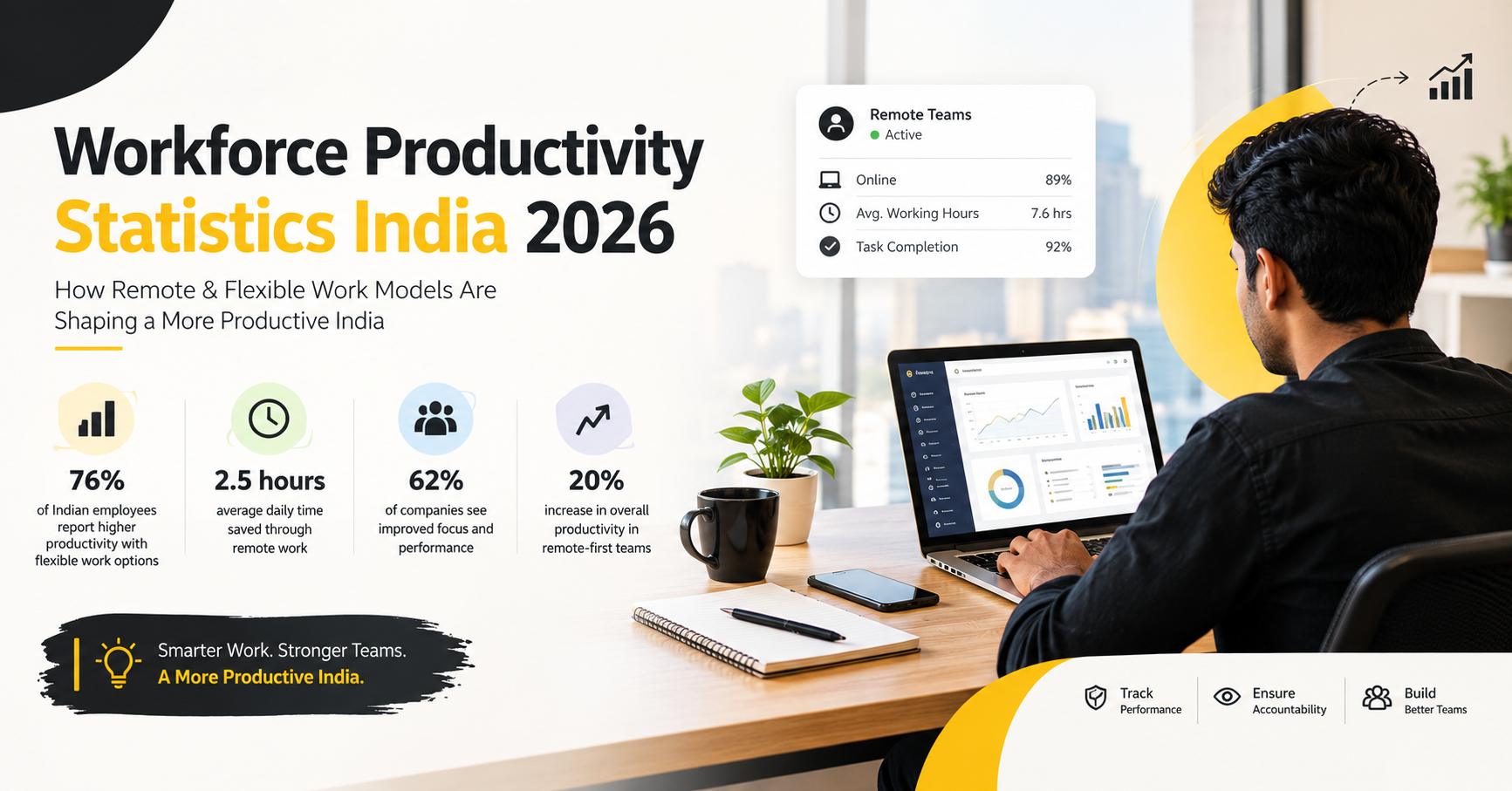
According to the statistics highlighted in the graphic, 76% of Indian employees report higher productivity with flexible work options. This indicates that flexibility can play an important role in how employees manage their work and daily responsibilities.
However, remote work also creates challenges for managers. Companies need visibility into work progress, task completion, working hours, and team performance without relying on constant physical supervision.
This is where modern workforce productivity software can help businesses understand employee activity and improve work management.
Key Workforce Productivity Statistics in India 2026
The graphic highlights several important statistics related to India's changing work environment:
- 76% of Indian employees report higher productivity with flexible work options.
- 2.5 hours is shown as the average daily time saved through remote work.
- 62% of companies report improved focus and performance.
- 20% increase in overall productivity is highlighted for remote-first teams.
These figures show why companies are paying greater attention to employee productivity, flexible work, and workforce management.
How Flexible Work Can Improve Employee Productivity
Flexible work gives employees greater control over where and, in some cases, when they work. This can reduce commuting time and allow employees to create working environments that suit their responsibilities.
When businesses combine flexible work with clear goals and effective communication, they can create a stronger productivity system.
Some potential benefits include:
1. Better Time Management
Employees can spend less time commuting and more time focusing on important tasks.
2. Improved Work-Life Balance
Flexible working arrangements can help employees manage professional and personal responsibilities more effectively.
3. Greater Focus
A suitable working environment can help employees concentrate on their tasks.
4. Better Team Performance
With the right communication and workforce management systems, remote teams can stay connected and accountable.
The Role of Employee Monitoring in Workforce Productivity
As remote and hybrid teams grow, companies need reliable ways to understand how work is progressing. Employee monitoring software can provide information about working hours, application usage, website activity, screenshots, attendance, and productivity trends, depending on the features of the platform.
For businesses, the goal should not simply be to monitor employees. Instead, the data should help managers identify workflow problems, understand workload patterns, and improve team productivity while respecting appropriate privacy and workplace policies.
Platforms such as Zneus can support businesses with features related to employee activity monitoring, time tracking, attendance, screenshots, application and website tracking, and productivity analytics.
Why Workforce Productivity Matters for Businesses
Improving workforce productivity can help businesses make better use of their available resources. When managers understand how teams spend their working time, they can identify inefficient processes and make informed decisions.
For example, if a team spends too much time on repetitive administrative work, management can look for ways to automate or simplify those processes.
Similarly, productivity data can help identify workload imbalances. If one employee or department consistently has a higher workload, managers can review task distribution and make adjustments.
How Businesses Can Improve Workforce Productivity in 2026
Businesses can take several practical steps to improve workforce productivity:
- Set clear and measurable goals.
- Use flexible or hybrid work models where appropriate.
- Track working hours and attendance accurately.
- Reduce unnecessary meetings and repetitive tasks.
- Use productivity analytics to understand workflow patterns.
- Improve communication between remote and office teams.
- Regularly review employee workload.
- Use technology to automate repetitive processes.
- Focus on results rather than simply measuring hours worked.
- Maintain transparent employee-monitoring and privacy policies.
Zneus and Modern Workforce Management
For companies managing remote, hybrid, or office-based employees, workforce management technology can provide useful visibility into daily work patterns.
Zneus employee monitoring software combines features such as time tracking, attendance monitoring, screenshots, application and website tracking, leave management, and productivity analytics. These capabilities can help businesses understand workforce activity and manage distributed teams more effectively.
The important objective is not simply to collect employee data. Businesses should use productivity information to identify opportunities for better processes, balanced workloads, and improved team performance.
Conclusion
The future of workforce productivity in India is increasingly connected with flexible work, remote teams, digital collaboration, and workforce management technology. The statistics highlighted in the Workforce Productivity Statistics India 2026 graphic demonstrate the growing importance of flexible working models and productivity-focused management.
As businesses continue to adopt hybrid and remote work, measuring productivity through meaningful outcomes, efficient time management, employee engagement, and effective workflows will become increasingly important.
With the right combination of people, processes, flexible work policies, and workforce productivity technology, Indian businesses can build more efficient and better-managed teams in 2026.