
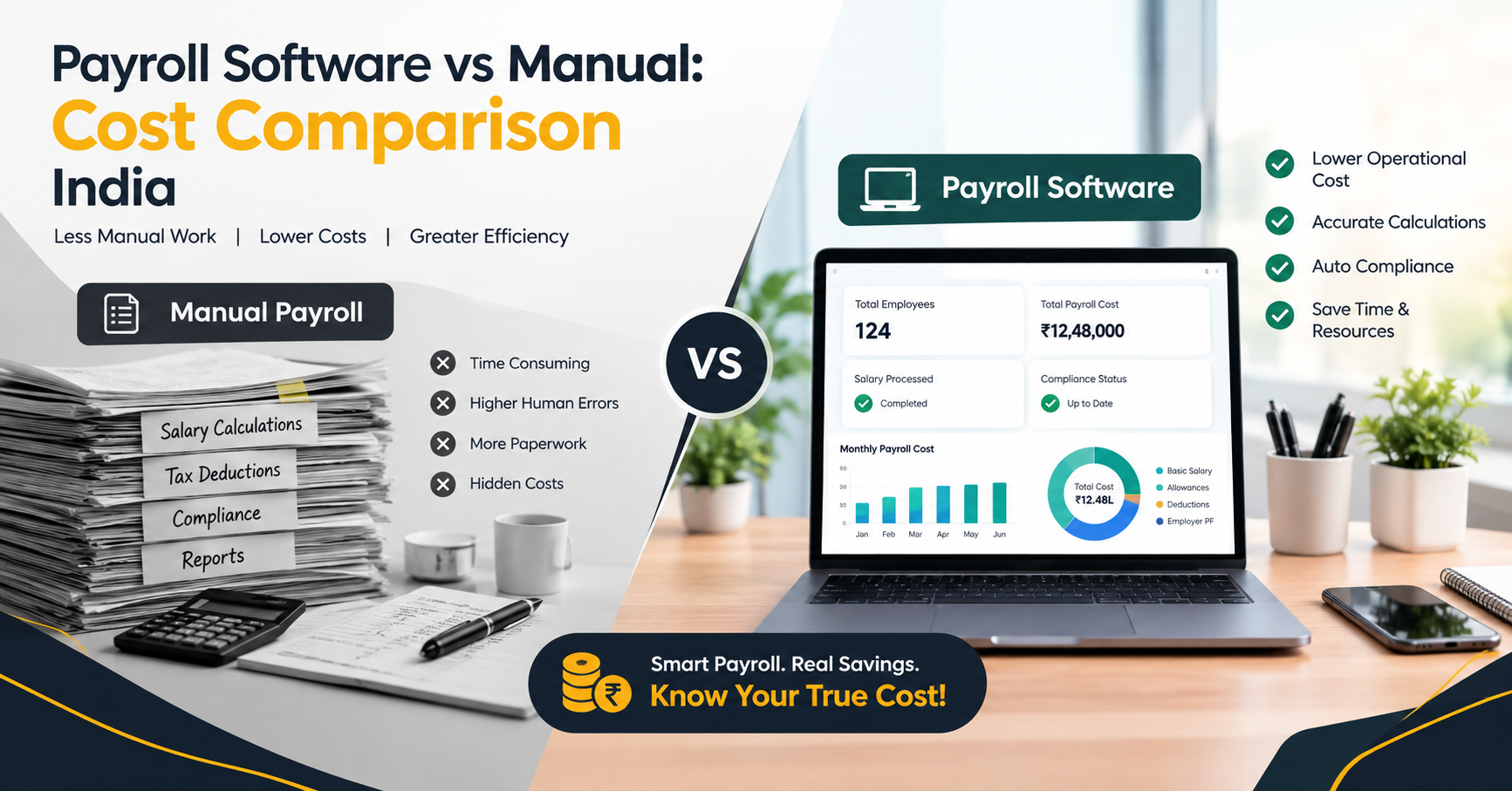
Payroll Software vs Manual: Cost Comparison India
Managing employee salaries every month is an important responsibility for every business. Payroll processing involves salary calculations, deductions, attendance data, tax calculations, compliance, payslips, and payroll reports. For small businesses, these tasks may initially be handled using spreadsheets and manual calculations. However, as the number of employees increases, manual payroll can become time-consuming and difficult to manage.
This is where payroll software can help businesses simplify salary processing and reduce the time spent on repetitive payroll tasks.
In India, businesses are increasingly comparing payroll software vs manual payroll to understand which approach can provide better efficiency, accuracy, and cost control.
What Is Manual Payroll?
Manual payroll means managing employee salary calculations and payroll-related activities without dedicated payroll automation software.
A company may use spreadsheets, calculators, attendance records, salary sheets, and physical documents to process monthly payroll.
Typical manual payroll activities include:
- Collecting employee attendance data
- Calculating basic salary and allowances
- Calculating deductions
- Managing leave and attendance information
- Preparing salary statements
- Generating payslips
- Maintaining payroll records
- Preparing compliance-related information
- Checking calculations manually
While manual payroll may work for a very small team, the workload generally increases as employee numbers grow.
What Is Payroll Software?
Payroll software is a digital solution designed to automate and organize payroll-related processes.
Instead of calculating everything manually, businesses can use payroll software to manage employee information, salary calculations, deductions, attendance data, payroll reports, and other payroll activities from one system.
Modern payroll systems can help HR and finance teams reduce repetitive administrative work and maintain payroll information in a more organized way.
Payroll Software vs Manual Payroll: Cost Comparison
The biggest difference between payroll software and manual payroll is not always the direct monthly expense.
Businesses should also consider the hidden costs associated with employee time, manual errors, paperwork, corrections, reporting, and payroll administration.
| Cost Factor | Manual Payroll | Payroll Software |
|---|---|---|
| Salary Calculation | Manual | Automated |
| Data Entry | High | Reduced |
| Payroll Processing Time | Higher | Lower |
| Human Errors | More likely | Reduced |
| Paperwork | More | Less |
| Payroll Reports | Manual | Automated/Quick |
| Employee Records | Spreadsheet/Paper | Centralized |
| Scalability | Difficult as team grows | Easier to scale |
| Administrative Work | High | Reduced |
The actual cost will depend on the company size, payroll complexity, software pricing, and internal processes. Therefore, businesses should compare both direct and indirect payroll costs before making a decision.
1. Employee Time Is a Major Payroll Cost
One of the biggest hidden costs of manual payroll is the time employees spend processing salaries.
For example, an HR or finance employee may need to spend several hours collecting attendance information, checking salary calculations, calculating deductions, correcting mistakes, and preparing payroll reports.
With payroll software, many repetitive activities can be automated or streamlined.
This allows HR and finance teams to spend less time on repetitive calculations and more time on important business activities.
2. Manual Payroll Can Increase the Risk of Errors
Payroll calculations need accuracy because even a small mistake can require additional checking and correction.
With manual payroll, employees may accidentally enter incorrect information into spreadsheets, use outdated data, or make calculation mistakes.
These errors can result in:
- Incorrect salary calculations
- Incorrect deductions
- Payroll corrections
- Additional administrative work
- Employee queries
- Delayed payroll processing
Payroll software can reduce manual data entry and automate calculations, helping businesses maintain more consistent payroll processes.
3. Paperwork and Record Management
Another cost associated with manual payroll is paperwork.
Businesses may need to maintain salary records, attendance information, payroll reports, employee documents, and other records.
As the organization grows, maintaining these records manually can become increasingly difficult.
A payroll software solution can provide a centralized digital system where payroll information can be managed and accessed more efficiently.
How Payroll Software Can Reduce Payroll Costs
The purpose of payroll software is not simply to replace spreadsheets. Its major advantage is reducing repetitive administrative work.
Here are some areas where payroll automation can help.
Automated Salary Calculations
Instead of calculating every employee's salary manually, payroll software can process salary information based on configured payroll rules and employee data.
Faster Payroll Processing
Automation can reduce the amount of repetitive work required during each payroll cycle.
Better Payroll Accuracy
Reducing manual calculations and repetitive data entry can help minimize avoidable payroll errors.
Easier Payroll Reports
Businesses can generate payroll-related reports more efficiently compared with manually preparing reports in spreadsheets.
Centralized Employee Payroll Data
Employee salary and payroll information can be managed from a centralized system instead of being distributed across multiple spreadsheets and documents.
Reduced Administrative Work
HR and finance teams can spend less time performing repetitive payroll activities.
Is Payroll Software More Expensive Than Manual Payroll?
At first glance, manual payroll may appear cheaper because there may be no dedicated software subscription.
However, the real cost of payroll also includes employee working hours, administrative effort, corrections, paperwork, reporting, and the time required to maintain payroll records.
For example, consider a business with a growing number of employees. If the payroll team spends several hours every month processing salaries manually, that employee time represents a business cost.
Therefore, when comparing payroll software vs manual payroll, businesses should calculate the total cost of payroll processing, rather than comparing only software subscription fees.
Example of Total Payroll Processing Cost
Suppose a company spends significant employee hours every month on:
- Salary calculations
- Attendance verification
- Deduction calculations
- Payroll checking
- Report preparation
- Payroll corrections
Even if the company does not purchase payroll software, these activities still have an internal cost.
A payroll software solution may introduce a software expense, but it can potentially reduce the amount of manual work required.
The right comparison is therefore:
Software Cost + Internal Payroll Cost
versus
Manual Payroll Cost + Employee Time + Administrative Effort + Correction Costs
This provides a more realistic payroll cost comparison.
Payroll Software for Growing Indian Businesses
For businesses with a small number of employees, manual payroll may initially appear manageable. However, payroll complexity can increase as the company grows.
More employees generally mean:
- More salary records
- More attendance data
- More deductions
- More payroll calculations
- More reports
- More employee queries
- More administrative work
This is why many growing businesses consider payroll software in India as part of their HR and payroll management process.
A digital payroll system can provide a more structured way to manage payroll as the workforce expands.
Key Benefits of Payroll Software
The main benefits of using payroll software include:
1. Saves Administrative Time
Automation can reduce repetitive payroll tasks.
2. Reduces Manual Calculations
Salary-related calculations can be processed through configured software rules.
3. Improves Data Organization
Employee payroll information can be maintained in one centralized system.
4. Simplifies Reporting
Payroll reports can be generated more efficiently.
5. Supports Business Scalability
A digital payroll system can make it easier to manage payroll as employee numbers increase.
6. Reduces Paperwork
Digital payroll records can reduce dependency on physical documents.
7. Helps Improve Payroll Management
HR and finance teams can manage payroll processes in a more structured way.
Manual Payroll vs Payroll Software: Which Cost Should You Consider?
Businesses should not look only at the price of payroll software.
Before choosing a payroll process, consider:
1. Number of Employees
How many employees are currently on payroll?
2. Payroll Complexity
How many salary components, deductions, attendance rules, and payroll requirements are involved?
3. HR Team Time
How many hours are spent processing payroll every month?
4. Error Correction
How much time is spent identifying and correcting payroll mistakes?
5. Reporting Requirements
How frequently does the company need payroll reports?
6. Future Growth
Will the number of employees increase significantly in the future?
These factors can help businesses understand their actual payroll processing cost.
Conclusion
The comparison between payroll software vs manual payroll is not simply about software subscription cost versus zero software cost.
Manual payroll can involve significant employee time, repetitive calculations, paperwork, data entry, reporting, and correction work. As a business grows, these activities can become more difficult to manage efficiently.
Payroll software can automate many repetitive payroll tasks, organize employee payroll information, simplify calculations and reporting, and reduce administrative workload.
For Indian businesses evaluating their payroll process, the most useful approach is to calculate the total cost of payroll processing and compare the time, effort, accuracy, and administrative requirements of both methods.
Ultimately, understanding the real cost of manual payroll versus payroll software can help businesses make a more informed payroll management decision.