
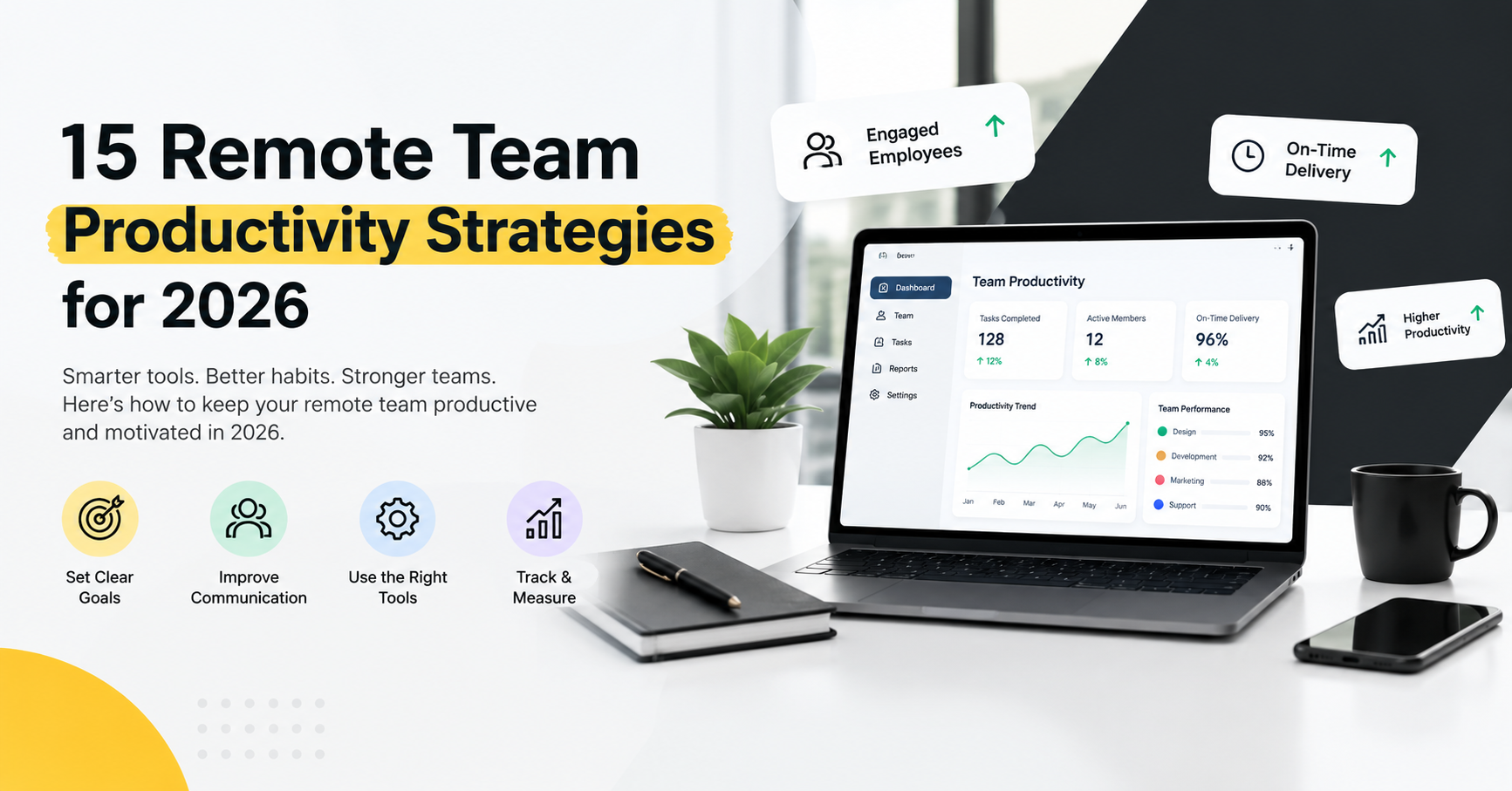
15 Remote Team Productivity Strategies for 2026
Remote teams have become an important part of modern business operations. As companies continue to work with employees across different cities, locations, and time zones, maintaining productivity requires more than simply assigning tasks. Teams need clear goals, effective communication, the right technology, regular performance tracking, and a work culture that supports accountability.
In 2026, businesses are increasingly focusing on smarter ways to manage distributed teams while giving employees enough flexibility to complete their responsibilities effectively. The goal is not to constantly monitor employees, but to create a structured environment where team members understand what is expected, have access to the right tools, and can measure their progress.
Here are 15 practical remote team productivity strategies for 2026 that businesses can use to improve collaboration, accountability, task management, and overall team performance.
1. Set Clear and Measurable Goals
Productivity starts with clear goals.
Every team member should understand what they need to accomplish, when it needs to be completed, and how success will be measured. Instead of giving employees vague instructions, managers should establish specific and measurable objectives.
For example, rather than saying:
“Complete the marketing work.”
A clearer goal would be:
“Publish three optimized blog articles and complete keyword research for the next campaign by Friday.”
Clear goals remove confusion and help employees prioritize their work.
2. Define Roles and Responsibilities
When several employees are working on the same project, unclear responsibilities can create delays and duplicated work.
Each team member should have clearly defined responsibilities. Employees should know:
- Which tasks belong to them
- Who they report to
- Which deadlines they are responsible for
- Who they need to collaborate with
- Which tasks require approval
A clear division of responsibilities makes it easier for managers to track progress and for employees to take ownership of their work.
3. Improve Team Communication
Communication is one of the biggest factors affecting remote team productivity.
Teams should establish clear communication practices instead of relying on constant messages. Important information should be organized so employees can easily find it when needed.
Businesses can establish communication rules such as:
- Use instant messaging for quick questions
- Use email for formal communication
- Use project management tools for task updates
- Use meetings for discussions that require collaboration
- Document important decisions for future reference
Better communication reduces unnecessary interruptions and keeps everyone aligned.
4. Use the Right Productivity Tools
The right technology can make managing a distributed team much easier.
Businesses can use different types of tools for different purposes, including:
- Project management software
- Task management platforms
- Time tracking tools
- Communication applications
- Document-sharing platforms
- Performance reporting dashboards
- Collaboration tools
The important thing is not to use dozens of applications. Instead, businesses should select tools that solve specific problems and integrate smoothly into the team's workflow.
5. Create a Structured Task Management System
Employees can become less productive when they have too many tasks without clear priorities.
A structured task management system helps employees understand what needs to be done first.
Tasks can be organized into categories such as:
To Do → In Progress → Review → Completed
Each task can include a deadline, priority level, assigned employee, and project information.
This gives both managers and employees a clear view of project progress.
6. Prioritize Important Work
Not every task has the same level of importance.
Teams should identify high-priority tasks and complete them before less important activities. Managers can classify work using categories such as:
- High Priority
- Medium Priority
- Low Priority
This helps employees focus their time on work that has the greatest impact on business objectives.
7. Track Progress Using Meaningful Metrics
Productivity should be measured using useful performance indicators rather than assumptions.
Businesses can track metrics such as:
- Tasks completed
- Project completion rate
- Deadline adherence
- Work progress
- Time spent on projects
- Team workload
- Productivity trends
These metrics can help managers understand how projects are progressing and where additional support may be required.
8. Reduce Unnecessary Meetings
Too many meetings can interrupt focused work.
Before scheduling a meeting, managers should consider whether the topic can be handled through a message, task update, or shared document.
When meetings are necessary, they should have:
- A clear purpose
- A defined agenda
- Relevant participants
- A reasonable time limit
- Clear action items
This allows employees to spend more time on productive work.
9. Encourage Better Time Management
Effective time management can significantly improve team productivity.
Employees can organize their working hours around important tasks, deadlines, and priorities. Managers can also encourage team members to divide large projects into smaller tasks.
For example:
Large Project → Smaller Tasks → Individual Deadlines → Final Completion
Breaking projects into manageable steps makes complex work easier to organize and track.
10. Monitor Workload and Avoid Employee Overload
Productivity is not simply about completing more tasks.
If employees continuously receive more work than they can reasonably manage, quality can decrease and deadlines can be missed.
Managers should regularly review workloads and identify employees who may have too many responsibilities.
A workload dashboard can help managers understand:
- Number of assigned tasks
- Pending work
- Completed work
- Upcoming deadlines
- Project distribution
This allows work to be distributed more effectively across the team.
11. Use Performance Dashboards
A productivity dashboard can give managers a centralized view of team performance.
Instead of checking multiple systems, managers can use dashboards to view important information in one place.
A dashboard might display:
Tasks Completed | Active Projects | Deadlines | Team Activity | Progress Trends
Visual reports make it easier to identify project delays, workload issues, and productivity trends.
12. Give Employees Regular Feedback
Regular feedback helps employees understand what they are doing well and where they can improve.
Feedback should not only happen during annual performance reviews. Managers can provide short and meaningful feedback throughout the year.
Good feedback should be:
- Specific
- Constructive
- Timely
- Related to measurable work
- Focused on improvement
This creates a continuous improvement culture within the team.
13. Encourage Accountability Without Micromanagement
Accountability is important for productivity, but excessive supervision can negatively affect the employee experience.
Instead of constantly asking employees:
“What are you doing right now?”
Managers can focus on outcomes:
“What has been completed, what is in progress, and what support is required?”
Clear goals, deadlines, task tracking, and performance reports can provide visibility without requiring constant manual supervision.
14. Recognize Good Performance
Recognition can help create a positive and motivated team environment.
Managers can recognize employees for:
- Completing important projects
- Meeting deadlines
- Helping teammates
- Improving processes
- Achieving performance goals
- Delivering high-quality work
Recognition does not always have to be financial. A simple acknowledgment of good work can also contribute to employee engagement.
15. Continuously Improve the Team's Workflow
Productivity strategies should not remain unchanged forever.
Businesses should regularly review how their teams work and identify areas that can be improved.
Managers can ask questions such as:
- Which processes are creating delays?
- Which tasks take too much time?
- Are employees using too many tools?
- Are deadlines being met?
- Is workload distributed fairly?
- Which activities can be automated?
- What information do managers need to make better decisions?
Regular workflow reviews help businesses adapt as their teams and projects change.
How Technology Can Support Remote Team Productivity
Technology plays an important role in modern team management. A well-designed productivity system can help businesses organize tasks, monitor project progress, analyze performance, and identify workflow problems.
For example, a manager may use a centralized dashboard to understand whether projects are progressing according to schedule.
A typical productivity dashboard can show:
128 Tasks Completed | 12 Active Members | 96% On-Time Delivery
These types of metrics provide a quick overview of team performance.
However, businesses should focus on useful performance information rather than collecting unnecessary data. The purpose of productivity technology should be to improve workflows, identify obstacles, and support employees.
How to Measure Remote Team Productivity
Measuring productivity requires more than simply counting hours.
A better approach is to combine several indicators.
Task Completion
How many assigned tasks are completed within the expected period?
Deadline Performance
Are employees and teams completing projects on time?
Project Progress
How quickly are projects moving from planning to completion?
Quality of Work
Are completed tasks meeting the required standards?
Workload Distribution
Is work distributed reasonably across team members?
Productivity Trends
Is team performance improving, remaining stable, or experiencing challenges over time?
Using multiple indicators provides a more complete picture of productivity.
Benefits of a Productive Remote Team
A well-organized remote team can provide several operational benefits to a business.
Better Collaboration
Clear communication and organized workflows make collaboration easier.
Faster Project Completion
Prioritized tasks and clear deadlines can help teams move projects forward efficiently.
Greater Visibility
Managers can understand project status without repeatedly requesting manual updates.
Better Workload Management
Performance dashboards and task systems can help identify uneven workloads.
Improved Accountability
Clear responsibilities and measurable objectives make ownership easier to establish.
More Efficient Processes
Regular analysis can reveal unnecessary steps and opportunities for improvement.
Final Thoughts
Remote team productivity in 2026 is increasingly about working smarter rather than simply working longer.
Businesses can improve team performance by setting clear goals, organizing responsibilities, improving communication, using appropriate technology, tracking meaningful metrics, managing workloads, and providing regular feedback.
The most effective approach is to create a system where employees understand their responsibilities, managers have visibility into project progress, and everyone has the tools needed to complete their work efficiently.
By implementing these 15 remote team productivity strategies, businesses can create more organized workflows, improve collaboration, and build a stronger foundation for managing distributed teams in 2026.