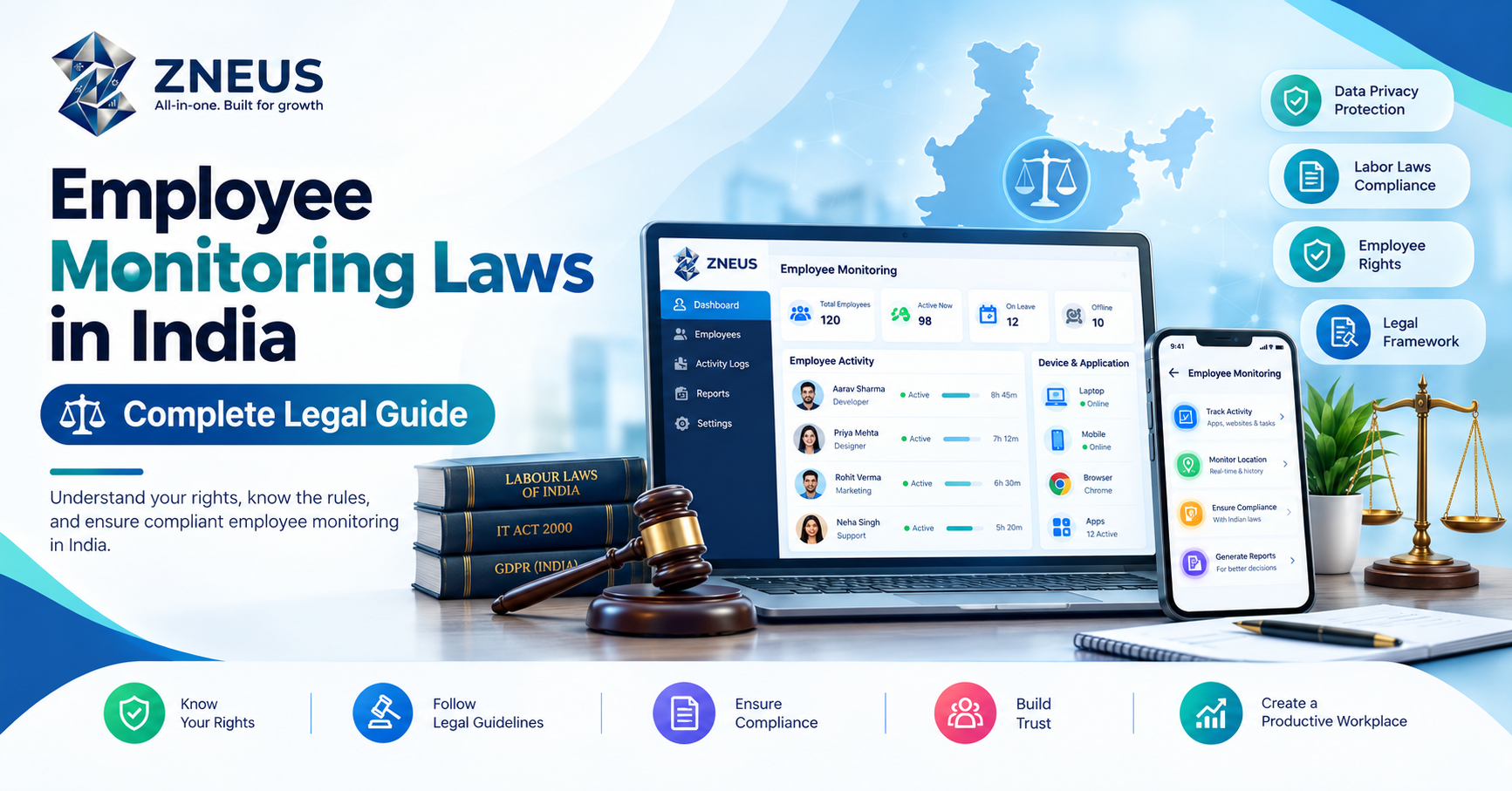
Employee Monitoring Laws in India: Complete Legal Guide
Employee monitoring has become an important part of modern business operations. Companies use digital tools to understand employee activity, protect company information, manage devices, improve workplace security, and maintain accountability. However, monitoring employees is not simply a matter of installing software and collecting every piece of information available.
In India, organisations need to consider privacy, data protection, cybersecurity, transparency, and legitimate business requirements when implementing employee monitoring systems. India’s privacy framework recognises privacy as a constitutionally protected right, while the Digital Personal Data Protection Act, 2023 establishes a framework governing the processing of digital personal data.
This is where businesses need to find the right balance: monitor what is genuinely required for business purposes while protecting employee privacy and personal data.
In this guide, we will understand what employee monitoring means, what companies can monitor, what they should avoid, how employee data should be handled, and how a platform such as ZNEUS can help organisations create a more structured and responsible monitoring environment.
What Is Employee Monitoring?
Employee monitoring refers to the use of technology, policies, and processes to understand employee activity within an organisation's authorised business environment.
Depending on the organisation and its requirements, monitoring may involve:
- Employee attendance
- Working hours
- Application usage
- Website activity
- Company-device activity
- System usage
- Task and productivity information
- Security events
- Login and logout activity
- Access to company resources
- Device information
- Organisational reports
The purpose should not be to watch employees unnecessarily.
Instead, monitoring should help an organisation answer practical questions such as:
Are company systems being used appropriately?
Are sensitive business resources being accessed securely?
Are employees following company technology policies?
Are organisational devices and applications being used efficiently?
Are there unusual activities that could create a security risk?
A good employee monitoring strategy therefore focuses on business visibility, security, accountability, and compliance, rather than excessive surveillance.
Is Employee Monitoring Legal in India?
There is no single Indian law that simply says that an employer can monitor everything an employee does.
Instead, employee monitoring can intersect with several areas of Indian law, including privacy, data protection, information technology and contractual obligations.
The Supreme Court of India has recognised privacy as a constitutionally protected right under Article 21, while also making clear that privacy is not an absolute right and that privacy limitations must satisfy applicable legal standards.
For businesses, this means that having a legitimate business reason for monitoring is extremely important.
An organisation should be able to explain:
- What information is being collected?
- Why is it being collected?
- How is it being used?
- Who can access it?
- How long will it be retained?
- How is it protected?
- Is the monitoring proportionate to the business requirement?
These questions become particularly important when monitoring involves personal data.
Employee Data and the Digital Personal Data Protection Act
The Digital Personal Data Protection Act, 2023 (DPDP Act) provides a framework for processing digital personal data in India. The Act defines personal data broadly as data about an individual who is identifiable by or in relation to that data, and defines processing to include activities such as collection, recording, organisation, storage, retrieval, use, sharing, disclosure and deletion.
Employee-related information can therefore become relevant from a data-protection perspective when an organisation collects or processes identifiable digital information.
For example, depending on the monitoring system being used, information could include:
- Employee name
- Employee ID
- Login information
- Attendance records
- Device information
- Application activity
- System access information
- Security logs
- Location-related information
- Performance-related information
The important point is that companies should treat employee information as data that requires responsible handling, rather than simply treating it as unrestricted company information.
What Can Companies Monitor?
The exact scope of monitoring should depend on the organisation's business requirements, internal policies, applicable law and the technology being used.
A company may have legitimate reasons to monitor areas such as:
1. Attendance
Attendance monitoring can help organisations understand:
- Login and logout patterns
- Working hours
- Leave records
- Attendance irregularities
- Shift-related information
This can make HR and administrative processes more organised.
2. Application Usage
Companies may need visibility into applications being used on company systems, particularly where software usage affects productivity, licensing, cybersecurity or compliance.
For example, an organisation may want to know whether employees are using:
- Approved business applications
- Unauthorised software
- Potentially risky applications
- Company-provided productivity tools
3. Website Activity
Website activity can become relevant when companies are protecting corporate networks from:
- Malware
- Phishing
- Unsafe websites
- Unauthorised downloads
- Security threats
However, monitoring should have a defined purpose and should not automatically become unrestricted surveillance.
4. Device Information
Organisations increasingly manage laptops, desktops and other company devices.
Device monitoring can help identify:
- Which devices are active
- Which devices are connected
- Security status
- Installed applications
- Unusual system activity
- Potential security issues
This can be particularly useful for IT and security teams.
5. Security Activity
One of the strongest reasons for monitoring is cybersecurity.
Companies need to identify unusual behaviour that could indicate:
- Account compromise
- Unauthorised access
- Suspicious application activity
- Data-security incidents
- Attempts to access restricted resources
The Information Technology Act, 2000 contains provisions relating to computer systems, data protection, monitoring/interception by authorised government mechanisms, and confidentiality/privacy offences, making cybersecurity and responsible information handling important considerations for organisations.
What Should Companies Be Careful About?
Employee monitoring becomes problematic when organisations collect information without a clear purpose or use monitoring tools in ways that unnecessarily invade privacy.
Companies should therefore be particularly careful with:
Excessive Personal Data Collection
Collecting more information than the business actually requires creates unnecessary privacy and security risks.
A better approach is:
Collect only what you genuinely need.
Unclear Monitoring Policies
Employees should not be left completely unaware of what company systems monitor.
An organisation should establish clear internal policies explaining relevant monitoring practices, purposes and responsibilities.
Unauthorised Access to Employee Data
Monitoring information can itself become sensitive organisational information.
Access should therefore be restricted to authorised personnel wherever appropriate.
Excessive Surveillance
Monitoring every aspect of an employee's behaviour simply because technology makes it possible is not necessarily a good business practice.
The better question is:
Does this monitoring serve a legitimate business or security purpose?
If the answer is no, the organisation should reconsider whether that data needs to be collected.
Why Transparency Matters
Transparency is one of the most important principles for responsible employee monitoring.
Employees should understand the organisation's monitoring framework through appropriate company policies, notices, agreements or other applicable processes.
A good policy can explain:
- What is monitored
- Why it is monitored
- Which devices or systems are covered
- Who can access monitoring information
- How information is used
- How information is protected
- How long information is retained, where applicable
- What employees should expect when using company systems
This creates a clearer relationship between the organisation and its employees.
Instead of employees feeling that they are being secretly watched, the organisation can establish a framework based on security, accountability and responsible technology use.
Employee Monitoring Should Be Purpose-Driven
A modern monitoring system should not simply collect data.
It should turn relevant data into useful business information.
For example:
Raw Data → Organised Information → Business Insight → Better Decision
Suppose an organisation identifies repeated access to an unauthorised application.
The goal should not simply be to record the employee's activity.
Instead, the organisation can use the information to determine:
- What happened?
- Why did it happen?
- Was it a policy violation?
- Was there a security risk?
- Does the employee need guidance?
- Does the organisation need to update its policy?
This approach makes monitoring more useful and responsible.
How ZNEUS Can Help With Employee Monitoring
ZNEUS can be positioned as an all-in-one business technology platform designed to give organisations better visibility into their operations.
Instead of looking at employee monitoring as a single feature, businesses can think of it as a combination of:
Employee Data + Activity + Security + Compliance + Privacy
A structured dashboard can help authorised teams bring relevant information together in one place.
With the right configuration and organisational policies, a platform like ZNEUS can help businesses understand important operational information without turning monitoring into uncontrolled surveillance.
Employee Dashboard
A central employee dashboard can give authorised administrators a structured overview of relevant employee and system information.
Instead of checking multiple systems individually, management and IT teams can work with organised information such as:
- Employee profiles
- Attendance
- Activity
- Device status
- Application information
- Security events
- Reports
This can make monitoring easier to manage and interpret.
Attendance Monitoring With ZNEUS
Attendance is one of the simplest and most practical areas of employee monitoring.
ZNEUS can help organisations structure attendance-related information so that authorised users can review relevant records more efficiently.
Businesses may use attendance information to understand:
- Working-hour patterns
- Attendance status
- Leave information
- Login activity
- Operational availability
The objective should be better workforce administration—not unnecessary surveillance.
Activity Monitoring
Employee activity monitoring can help organisations understand how company systems and resources are being used.
Depending on the organisation's configuration and policies, activity information may provide visibility into:
- Applications
- Websites
- Tasks
- System usage
- Relevant business activity
This can help organisations identify operational patterns and potential risks.
However, activity monitoring should always be connected to a clearly defined business purpose.
Device and Application Visibility
Modern organisations often have many devices and applications operating simultaneously.
This creates an IT-management challenge.
ZNEUS can help organisations organise information around:
Devices → Applications → Users → Activity → Security
This type of visibility can make it easier for IT teams to understand what is happening within the company's technology environment.
For example, an organisation may identify an unknown application installed on a company device and investigate whether it presents a security or compliance concern.
Security Monitoring
Employee monitoring and cybersecurity can overlap significantly.
A compromised employee account can potentially become an entry point into a company's systems.
Security-focused monitoring can help organisations identify unusual activity and investigate potential incidents.
Useful security indicators may include:
- Unusual access
- Suspicious application activity
- Unexpected device behaviour
- Unauthorised resource access
- Security alerts
The goal is to protect the organisation and its data.
Compliance and Employee Monitoring
Compliance should be built into the monitoring process rather than treated as an afterthought.
Companies should develop internal policies around:
- Data collection
- Data access
- Data security
- Monitoring purposes
- Employee communication
- Retention
- Incident handling
- Access controls
The DPDP Act also establishes concepts such as Data Fiduciaries and Data Processors and defines processing broadly, meaning organisations should pay attention to how personal data moves through their technology environment.
Privacy Should Remain a Core Principle
One of the most important messages for businesses is simple:
Employee Monitoring ≠ Unlimited Surveillance
Technology may allow an organisation to collect large amounts of information, but that does not automatically mean the organisation should collect everything.
Privacy should remain part of the monitoring strategy.
The Supreme Court has discussed the risks created by modern technology, including surveillance, profiling, tracking and the extensive generation of digital footprints.
For this reason, organisations should consider:
Purpose
Why is the information required?
Proportionality
Is the level of monitoring appropriate for the purpose?
Security
How will the information be protected?
Access
Who actually needs to see it?
Transparency
Do employees understand the relevant monitoring practices?
These principles can help create a more balanced monitoring environment.
7 Best Practices for Legal and Responsible Employee Monitoring
1. Create a Clear Monitoring Policy
Document what the organisation monitors and why.
2. Define the Business Purpose
Every monitoring category should have a genuine reason behind it.
3. Avoid Unnecessary Data
Do not collect information simply because the technology allows it.
4. Protect Monitoring Data
Employee monitoring data should itself be treated as information requiring appropriate security.
5. Restrict Access
Only authorised personnel should have access according to their responsibilities.
6. Review Your Policies Regularly
Technology and data-protection requirements evolve, so internal policies should be reviewed periodically.
7. Use Monitoring to Improve Operations
The purpose should be better security, accountability, administration and decision-making—not creating a culture of constant surveillance.
ZNEUS: Bringing Employee Visibility, Security and Compliance Together
For organisations, employee monitoring becomes much more useful when information is structured rather than scattered across different systems.
A platform such as ZNEUS can help bring together important operational areas such as:
👥 Employee Data
Manage relevant employee information in an organised environment.
🕐 Attendance
Understand attendance and working-hour information.
📊 Activity
Review relevant applications, websites and business activity.
💻 Device Management
Maintain visibility into organisational devices and technology resources.
🛡️ Security
Identify potential risks and unusual activity.
📋 Compliance
Support internal policies and responsible data-management practices.
🔐 Privacy
Keep privacy and responsible data handling at the centre of the monitoring framework.
The objective is to create visibility without unnecessary intrusion.
How Businesses Can Build a Better Monitoring Strategy
Before implementing any employee monitoring solution, organisations should ask five important questions:
Question 1: What problem are we trying to solve?
Is the goal attendance management, cybersecurity, productivity analysis, device management or compliance?
Question 2: What information do we actually need?
Identify the minimum relevant data required to achieve the objective.
Question 3: Who needs access?
Not every administrator needs access to every category of information.
Question 4: How will employees be informed?
Establish appropriate policies and communication.
Question 5: How will the information be protected?
Monitoring information can become valuable business data, so security controls are essential.
This five-step approach can help companies move from "monitor everything" to "monitor what matters."
Final Thoughts
Employee monitoring in India is not simply a technology question. It is a combination of business requirements, privacy, data protection, cybersecurity, transparency and responsible organisational policies.
Companies can use monitoring technology to improve attendance management, understand authorised activity, protect company devices, detect security risks and strengthen operational visibility. But monitoring should be designed carefully so that legitimate business objectives do not become excessive surveillance.
With a structured platform such as ZNEUS, organisations can bring employee information, activity, device visibility, security and compliance into a more organised environment.
The goal should be simple:
Monitor Responsibly. Protect Data. Improve Security. Build Trust.
And that is ultimately what modern employee monitoring should be about—not watching employees for the sake of watching them, but giving organisations the right visibility to operate securely, efficiently and responsibly.
Disclaimer: This article is intended for general informational purposes and should not be treated as legal advice. Employee-monitoring practices should be reviewed against the laws, regulations, contracts, policies and specific circumstances applicable to the organisation.