How to Track Remote Employees Without Micromanaging
Managing a remote team can be challenging. When employees are working from different locations, managers often worry about productivity, project progress, deadlines, and communication. The natural reaction can be to constantly ask for updates, check activity, or monitor every small task. However, too much monitoring can quickly turn into micromanagement, which can reduce employee trust, motivation, and productivity.
The better approach is to create a system where managers can track progress, understand team performance, and stay informed without constantly watching over employees.
With the right processes and digital tools, businesses can build a remote team environment based on accountability, transparency, communication, and trust.
This is where solutions like ZNEUS can help businesses manage their teams more efficiently by bringing important work and performance insights together in one place.
Why Tracking Remote Employees Matters
Managing a distributed team requires visibility. Managers need to know whether projects are moving forward, deadlines are being met, and employees have the resources they need to complete their responsibilities.
However, tracking should not mean watching employees every minute.
The goal should be to understand:
- What work has been completed?
- What tasks are currently in progress?
- Are projects moving according to schedule?
- Are deadlines being met?
- Where is the team facing challenges?
- Which areas need support?
- How can managers improve overall productivity?
When tracking focuses on these questions, it becomes a management and productivity tool rather than a surveillance system.
A good tracking system gives managers the information they need while allowing employees the freedom to manage their responsibilities independently.
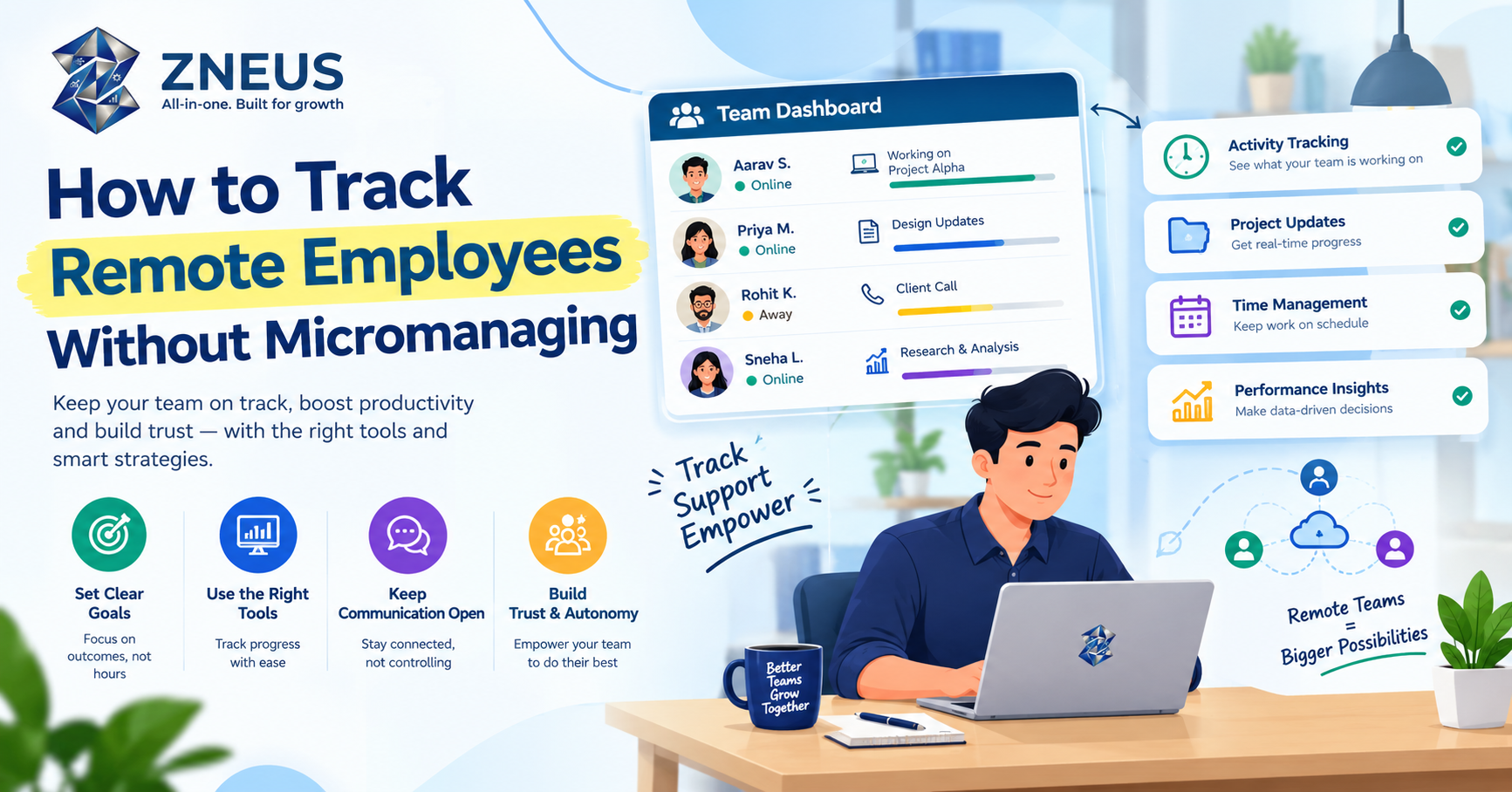
1. Set Clear Goals and Expectations
The first step toward tracking employees without micromanaging is to establish clear goals.
Employees should know exactly what they are expected to accomplish, when the work needs to be completed, and how success will be measured.
Instead of saying:
“Stay online and keep working throughout the day.”
Managers can focus on measurable outcomes such as:
- Complete the assigned project by Friday.
- Submit the weekly report by the end of the day.
- Finish the required client updates.
- Achieve the agreed project milestones.
- Resolve assigned customer issues within the expected timeline.
This creates a much healthier approach to employee tracking.
When expectations are clear, managers do not need to repeatedly ask, “What are you working on?”
They can simply check the progress of the assigned objectives.
Focus on Outcomes, Not Constant Activity
One of the biggest mistakes businesses make is measuring productivity only by how long an employee appears to be active.
Being online for eight hours does not necessarily mean eight hours of productive work.
Instead, businesses should consider:
Goals → Tasks → Progress → Results
This approach provides a much clearer picture of employee performance.
2. Use the Right Tools to Track Progress
Technology can make remote team management significantly easier.
Instead of depending on constant messages, calls, spreadsheets, and manual updates, businesses can use centralized digital tools to understand project progress and employee activity.
A good employee management or team productivity system can help managers get visibility into important areas such as:
- Task progress
- Project updates
- Time management
- Team activity
- Performance insights
- Deadlines
- Work allocation
- Productivity trends
The purpose of these tools should not be to control employees.
The purpose is to give managers visibility while giving employees independence.
One Dashboard, Better Visibility
A centralized dashboard can make it easier for managers to understand what is happening across the team.
Instead of asking multiple employees for individual updates, managers can look at the available information and identify which projects are progressing normally and which may require attention.
This can save time for both managers and employees.
For growing businesses, platforms such as ZNEUS can support a more organized approach by bringing team-related information and business processes into one ecosystem.
3. Keep Communication Open
Technology alone cannot successfully manage a remote team.
Strong communication is equally important.
Employees should feel comfortable communicating when they:
- Need clarification
- Face a project problem
- Require additional resources
- Have a deadline concern
- Need help from another department
- Want to share an idea or improvement
Managers should create a communication culture where employees do not feel that every message is an interrogation.
Instead of constantly asking:
“Why isn't this finished yet?”
Managers can ask:
“Is there anything blocking you from completing this task?”
This small change in communication can make a major difference.
It changes the manager's role from controller to supporter.
4. Build Trust and Autonomy
Trust is one of the most important elements of successful remote team management.
Employees perform better when they understand that their managers trust them to complete their responsibilities.
Micromanagement often happens when managers feel they need to control every detail of an employee's work.
But effective management works differently.
Managers should provide:
Clear Goals + Proper Tools + Regular Communication + Trust
Once employees understand what is expected from them, they should have reasonable freedom to decide how they accomplish their work.
Give Employees Ownership
Instead of monitoring every activity, managers can give employees ownership of specific tasks and projects.
For example:
Manager:
“Here is the project objective and deadline.”
Employee:
“I will manage the tasks and deliver the required result.”
Manager:
“I'll track the progress and help if you face any problems.”
This creates accountability without creating unnecessary pressure.
Track Progress Without Watching Every Minute
One of the biggest differences between productive tracking and micromanagement is what you choose to measure.
Micromanagement focuses heavily on individual activities.
Smart employee tracking focuses on progress and outcomes.
For example, managers can monitor:
Project Progress
Is the project moving toward completion?
Task Completion
Are assigned tasks being completed on time?
Time Management
Is work being managed efficiently?
Performance Insights
Are there noticeable productivity patterns that require attention?
Team Collaboration
Are employees communicating and working effectively with one another?
This gives managers meaningful information without requiring them to constantly interrupt employees.
Use Data to Identify Problems Early
Another advantage of proper employee tracking is that it can help managers identify potential problems before they become serious.
Suppose a project is consistently falling behind schedule.
Instead of immediately blaming the employee, a manager can investigate the situation.
Maybe:
- The workload is too high.
- The deadline was unrealistic.
- The employee is waiting for another department.
- The project requirements changed.
- The employee needs additional resources.
- Communication between teams is creating delays.
Data can help managers identify these patterns.
The goal should not be:
“Who is responsible?”
The better question is:
“What is preventing the team from performing at its best?”
That shift creates a much more productive workplace culture.
Track Employees, But Don't Create a Surveillance Culture
Businesses should be careful about how employee tracking is implemented.
Employees should understand what is being tracked, why it is being tracked, and how the information will be used.
Transparency is extremely important.
When employees understand that tracking exists to improve productivity, manage projects, identify challenges, and support the team, they are more likely to accept it.
But when employees feel they are being watched constantly, tracking can create stress and reduce trust.
Therefore, businesses should always aim for a balance between:
Visibility and Privacy
Accountability and Freedom
Productivity and Trust
How ZNEUS Can Help Businesses Manage Teams More Effectively
For modern businesses, managing multiple employees, projects, tasks, and performance information can become complicated.
A centralized platform can make this process easier by giving managers better visibility into important business activities.
ZNEUS follows an all-in-one approach, helping businesses bring different operational requirements together rather than depending on disconnected systems.
For team management, the right digital environment can help businesses focus on areas such as:
- Activity tracking
- Project updates
- Time management
- Performance insights
- Team coordination
- Productivity improvement
- Business growth
The objective is simple:
Track the work. Support the employee. Improve the result.
Not:
Watch every move.
The Best Remote Employee Tracking Strategy
A successful employee tracking strategy does not depend on one software feature.
It depends on creating the right management system.
A simple framework can be:
1. Set Clear Goals
Employees should know what they need to achieve.
2. Assign Responsibilities
Every task should have clear ownership.
3. Track Progress
Use appropriate tools to understand project and task status.
4. Communicate Regularly
Keep communication open without unnecessary interruptions.
5. Identify Roadblocks
Use progress information to find problems early.
6. Provide Support
Help employees when they need resources or guidance.
7. Measure Results
Focus on outcomes instead of simply measuring activity.
8. Build Trust
Give employees the independence to complete their responsibilities.
This creates a system where managers stay informed without becoming overly involved in every small decision.
From Tracking to Supporting
The biggest mindset change for managers is understanding that employee tracking should not be about control.
It should be about support.
When a manager sees that a project is behind schedule, the first response should not automatically be criticism.
Instead, the manager can ask:
“What can we do to get this project back on track?”
When an employee's workload increases, the manager can look at task allocation.
When productivity decreases, the manager can investigate the reason.
When a project succeeds, the team can understand what worked well.
This is how data becomes useful.
Remote Teams Need Visibility, Not Micromanagement
A successful remote team needs enough visibility for managers to understand what is happening, but enough freedom for employees to do their jobs effectively.
The ideal environment is one where:
Managers know what is happening.
Employees know what is expected.
Teams know what needs to be completed.
Everyone can communicate when help is required.
And most importantly:
People are trusted to do their work.
With the right combination of clear goals, effective communication, smart tracking tools, and trust, businesses can create productive remote teams without creating a culture of constant monitoring.
Conclusion
Tracking remote employees does not have to mean micromanaging them.
The most effective approach is to focus on goals, progress, communication, performance, and outcomes rather than constantly monitoring every minute of an employee's day.
Businesses can use digital tools to understand project progress, manage tasks, improve time management, and gain valuable performance insights. At the same time, managers should give employees the autonomy and trust they need to perform their responsibilities.
The right technology can provide visibility.
The right management approach can build trust.
And the combination of both can create a stronger, more productive team.
With an all-in-one business approach like ZNEUS, organizations can move toward smarter team management where the focus is not simply on tracking employees, but on helping teams perform better, stay connected, and grow together.