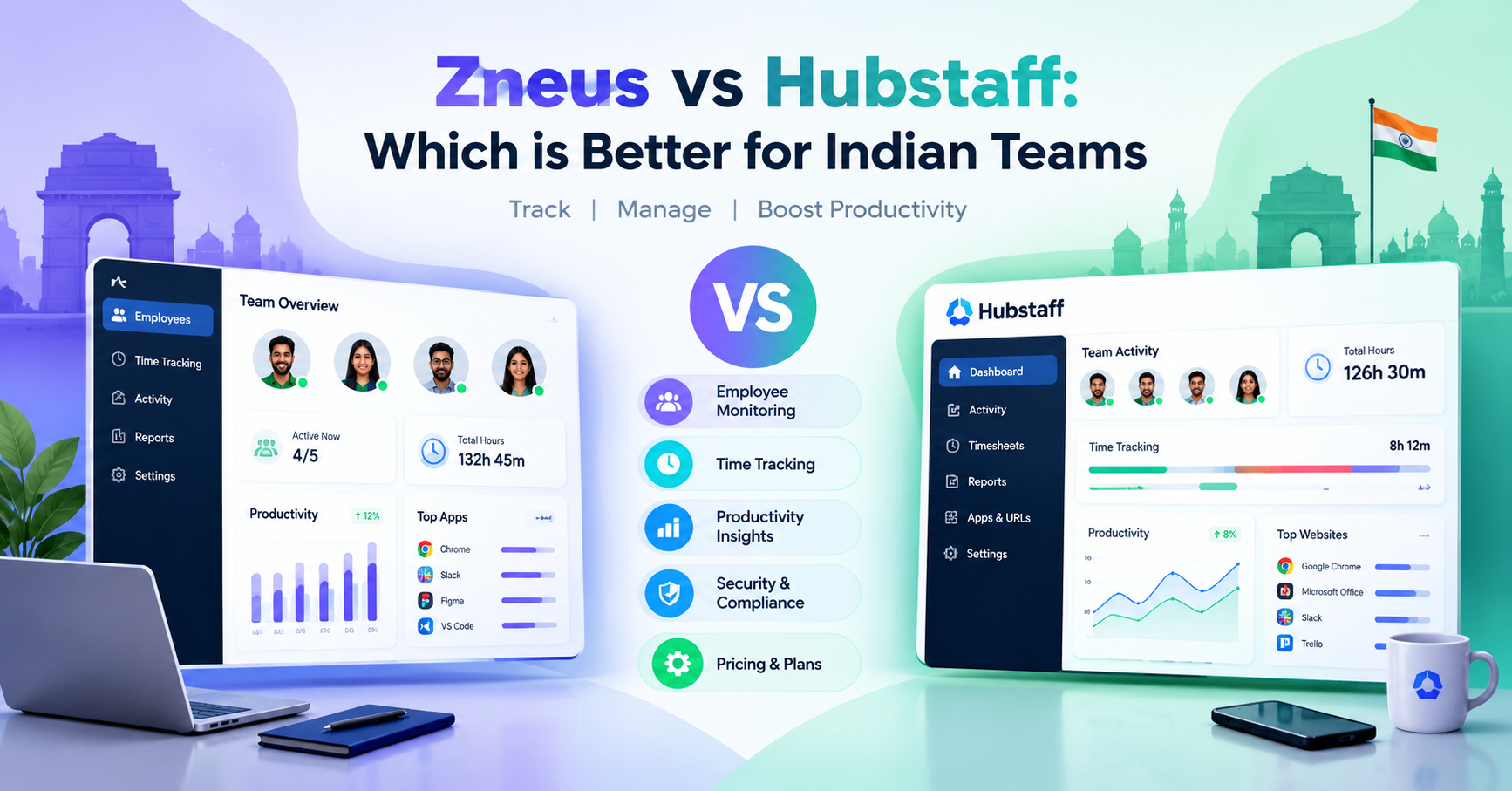
Zneus vs Hubstaff: Which is Better for Indian Teams?
Managing employees efficiently has become an important part of modern business operations. As companies grow, managers need better ways to understand employee activity, track working hours, measure productivity, and generate useful reports. This is where employee monitoring and time tracking software can make a significant difference.
Among the available solutions, Zneus vs Hubstaff is an interesting comparison for businesses looking for a reliable platform to manage employee productivity and work activity. Both platforms focus on helping organizations track time, understand employee activity, and improve overall workforce management. However, the right choice depends on the specific requirements of your team, the features you need, and how you want to manage employee performance.
For Indian teams, choosing the right employee management solution can help businesses create better workflows, improve accountability, and make day-to-day management easier.
Zneus vs Hubstaff: Understanding the Difference
When comparing Zneus vs Hubstaff, the first thing businesses should consider is what they actually need from employee monitoring software.
A good platform should provide more than just a timer. Businesses may need employee activity monitoring, time tracking, productivity insights, reports, application usage information, and security controls from a single dashboard.
The purpose of these tools is not simply to watch employees. Instead, they can help managers understand how work is being performed, identify workflow issues, analyze productivity patterns, and make better management decisions.
Both Zneus and Hubstaff provide tools designed around workforce management, but businesses should evaluate each solution according to their own operational requirements.
Employee Monitoring
One of the most important areas in the Zneus vs Hubstaff comparison is employee monitoring.
Employee monitoring software can give managers a centralized view of team activity. Instead of depending entirely on manual updates, managers can use software-based information to understand employee activity and working patterns.
With an employee monitoring platform, businesses can potentially understand:
- Employee activity levels
- Working hours
- Application usage
- Website activity
- Productivity patterns
- Team performance
- Work-related activity
- Daily and weekly reports
This information can make workforce management more structured.
For managers handling multiple employees, having this information in one dashboard can save time and make it easier to identify areas where teams may need additional support.
The important point is that employee monitoring should be implemented transparently and responsibly. Employees should understand what information is collected and why it is being used.
Time Tracking for Better Workforce Management
Time tracking is another major factor when evaluating Zneus vs Hubstaff.
For businesses, knowing how much time employees spend on different tasks can help improve planning and resource management. Manual timesheets can sometimes be difficult to maintain, especially when teams become larger.
Time tracking software can simplify this process by creating a more organized record of working hours.
Managers can use time tracking information to:
- Understand working hours
- Monitor task duration
- Improve workload planning
- Analyze productivity trends
- Prepare reports
- Identify inefficient workflows
- Manage team schedules more effectively
For Indian companies managing growing teams, centralized time tracking can reduce unnecessary administrative work.
Instead of collecting information from multiple sources, managers can access relevant workforce information through a single platform.
Productivity Insights
Productivity is not simply about how many hours someone works. A better approach is to understand how employees spend their working time and whether their activities are contributing to business goals.
This is another important consideration in the Zneus vs Hubstaff comparison.
Productivity insights can help managers identify patterns in employee activity. For example, a manager may notice that certain applications are frequently used, particular tasks take longer than expected, or a project requires more resources than originally planned.
These insights can support better decision-making.
A productivity dashboard may help businesses understand:
Employee Activity → Time Spent → Work Patterns → Productivity Insights → Better Decisions
This makes employee productivity software useful not only for monitoring but also for improving business processes.
Reports and Analytics
Reports are an essential feature for any organization that wants to manage its workforce using data.
When comparing Zneus vs Hubstaff, businesses should look at how easily they can access and understand workforce reports.
Instead of reviewing individual employee updates manually, managers can use reports to get a broader overview of team activity.
Useful reports may include information about:
- Total working hours
- Employee activity
- Productivity levels
- Application usage
- Team performance
- Time utilization
- Activity trends
These reports can help management identify patterns over time.
For example, if a particular team consistently spends more time on a specific process, management can investigate whether the process can be optimized.
This turns employee monitoring software into a management and business intelligence tool rather than simply an employee tracking system.
Application and Website Activity
Modern employees often use multiple applications and websites throughout the working day. Understanding how these resources are being used can provide useful productivity information.
This is why application and website activity can also be considered when evaluating Zneus vs Hubstaff.
Activity information can help managers understand which tools are being used by employees and how work-related applications contribute to daily workflows.
For example, a team may regularly use communication tools, project management software, design applications, development tools, or business platforms.
By understanding application usage, businesses can potentially identify:
- Frequently used applications
- Work-related activity
- Productivity patterns
- Unnecessary digital distractions
- Tools used by different teams
However, businesses should always establish clear monitoring policies and communicate them to employees.
Security and Compliance
Security is another important factor for Indian businesses choosing employee monitoring software.
Employee-related information can be sensitive, so organizations should consider how data is collected, stored, accessed, and managed.
When evaluating Zneus vs Hubstaff, companies should pay attention to security-related controls and administrative features.
A business should ideally have appropriate controls for:
- User access
- Account management
- Data protection
- Administrative permissions
- Employee information
- Reporting access
Security becomes even more important when organizations have larger teams and multiple managers accessing workforce information.
A well-managed employee monitoring solution should help businesses maintain visibility while also respecting employee privacy and organizational policies.
Pricing and Plans
Pricing is naturally an important consideration in the Zneus vs Hubstaff decision.
Businesses should not select software only because it has a lower price. Instead, they should consider the overall value they receive from the platform.
When comparing pricing and plans, companies should evaluate:
- Number of employees supported
- Available features
- Time tracking capabilities
- Employee monitoring features
- Productivity reports
- Administrative controls
- Scalability
- Support
- Overall usability
A solution that provides the right combination of features can deliver better value than a cheaper platform that does not meet the company's requirements.
For small businesses, startups, agencies, and growing Indian teams, scalability can be particularly important. The software should continue to remain useful as the organization expands.
Zneus vs Hubstaff for Indian Teams
The needs of Indian businesses can vary significantly depending on their industry and team structure.
A small startup may need simple employee time tracking, while a larger organization may require detailed employee monitoring, productivity reporting, team dashboards, and administrative controls.
Therefore, there is no universal answer to the question of Zneus vs Hubstaff: Which is Better for Indian Teams?
The better option is the one that fits the organization's actual workflow.
Businesses should ask themselves:
- How many employees need to be managed?
- Do managers need employee activity monitoring?
- Is time tracking important?
- Are productivity reports required?
- Does the business need application and website activity insights?
- How important are security controls?
- Does the platform need to scale with the company?
- Which features provide the most value for the business?
Answering these questions can make the selection process much easier.
Why Employee Monitoring Software Matters
Employee monitoring software can provide businesses with greater visibility into daily operations.
Without a centralized system, managers may depend on manual reports, spreadsheets, individual updates, or separate applications. As teams grow, managing all this information can become increasingly difficult.
A centralized platform can bring important information together.
For example:
Employees → Activity → Time Tracking → Productivity → Reports → Management Decisions
This type of workflow can help organizations make decisions based on actual workforce data.
The goal should not be to create unnecessary pressure on employees. Instead, businesses should use employee monitoring software to improve transparency, identify process problems, manage workloads, and support productivity.
Zneus vs Hubstaff: Which One Should You Choose?
The final decision in the Zneus vs Hubstaff comparison depends on what your organization expects from its workforce management software.
If your priority is employee monitoring, time tracking, productivity insights, reporting, application activity, security, and centralized workforce management, you should compare both platforms feature by feature before making a decision.
For Indian teams, other factors such as ease of implementation, scalability, usability, pricing, and the type of workforce being managed should also be considered.
Rather than choosing a platform based only on brand popularity, businesses should focus on the features that solve their actual management challenges.
Final Verdict: Zneus vs Hubstaff
The Zneus vs Hubstaff comparison shows that employee monitoring and time tracking platforms can play an important role in modern workforce management.
Both solutions are designed to help businesses gain better visibility into employee activity and working time. However, the best choice depends on the organization's size, workflow, management style, budget, and required features.
For Indian teams, the ideal employee monitoring software should provide a balance between productivity, transparency, time tracking, reporting, security, and ease of management.
Before selecting a platform, businesses should carefully compare employee monitoring, time tracking, productivity insights, reports, application activity, security features, and pricing plans.
Ultimately, the right software is not simply the one with the longest feature list. It is the platform that helps your organization manage employees more efficiently, understand productivity patterns, and make better decisions using meaningful workforce data.