
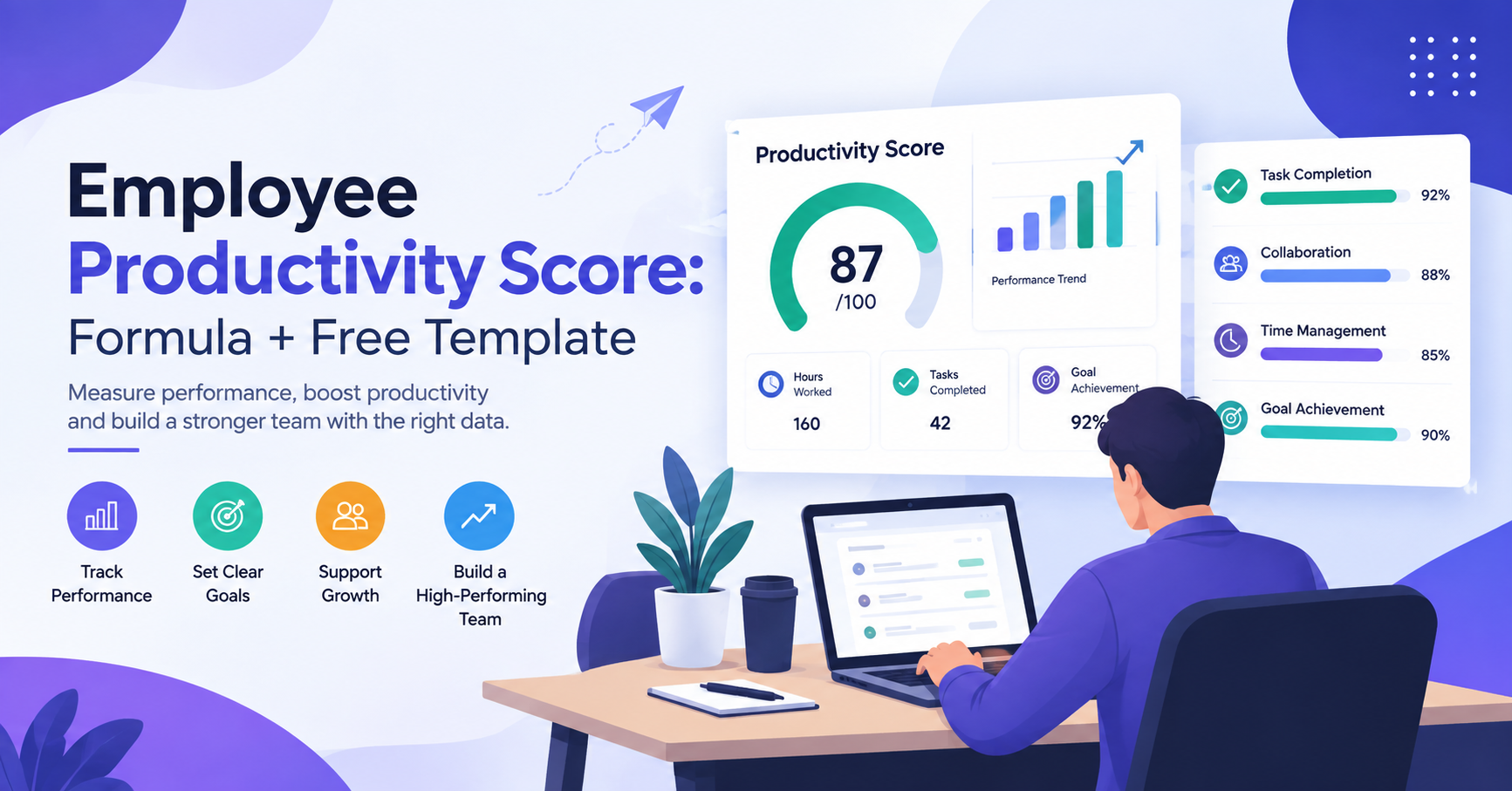
Employee Productivity Score: Formula + Free Template
Employee productivity is one of the most important factors that can determine the success of a business. When employees are able to complete their tasks efficiently, achieve their goals, manage their time properly, and contribute to team objectives, the overall performance of the organization improves. However, measuring employee productivity is not always as simple as looking at the number of tasks completed.
This is where an Employee Productivity Score can be useful.
An Employee Productivity Score provides a structured way to evaluate employee performance using measurable factors such as task completion, goal achievement, time management, work output, and collaboration. Instead of relying only on assumptions or subjective opinions, businesses can use productivity data to understand how employees are performing and where improvements may be required.
A well-designed productivity score can also help managers have more meaningful performance discussions with employees. The purpose should not be to micromanage people, but to understand performance patterns, identify challenges, recognize strong work, and provide the right support.
What Is an Employee Productivity Score?
An Employee Productivity Score is a numerical measurement used to evaluate an employee's overall productivity based on selected performance metrics.
For example, a company may evaluate productivity using:
- Task completion
- Goal achievement
- Time management
- Work output
- Quality of work
- Collaboration
- Project completion
- Attendance or availability, where relevant
These factors can be combined into a single score, such as 87/100, to provide an easy-to-understand overview of employee productivity.
However, productivity should not be treated as a single number that defines an employee. Different roles have different responsibilities, and productivity should always be evaluated according to the employee's role, goals, workload, and quality of work.
Why Is Employee Productivity Measurement Important?
Without measurable performance data, managers may find it difficult to understand whether employees are meeting expectations.
An employee may appear busy throughout the day but still struggle to complete important tasks. On the other hand, another employee may complete their assigned work quickly while maintaining excellent quality.
This is why organizations need a balanced approach to productivity measurement.
An Employee Productivity Score can help businesses:
- Understand employee performance
- Track progress toward goals
- Identify productivity improvements
- Recognize high-performing employees
- Identify areas where employees need support
- Improve workload management
- Make performance reviews more objective
- Monitor project and task progress
- Encourage better time management
- Build stronger and more productive teams
The objective is to use data as a tool for improvement rather than simply assigning a number to an employee.
Employee Productivity Score Formula
There is no single universal formula that works for every company. The formula should be customized according to the employee's role and the metrics that matter most.
A simple weighted formula can be:
Employee Productivity Score = (Task Completion × Weight) + (Goal Achievement × Weight) + (Time Management × Weight) + (Quality/Performance × Weight)
For example, a company could assign the following weights:
| Productivity Metric | Weight |
|---|---|
| Task Completion | 30% |
| Goal Achievement | 30% |
| Time Management | 20% |
| Quality of Work | 20% |
| Total | 100% |
Suppose an employee has the following scores:
- Task Completion: 92%
- Goal Achievement: 90%
- Time Management: 85%
- Quality of Work: 88%
The productivity score can then be calculated by applying the appropriate weights to each metric.
Productivity Score = (92 × 0.30) + (90 × 0.30) + (85 × 0.20) + (88 × 0.20)
This produces an overall score that provides a more balanced view of employee productivity.
Key Metrics Used to Calculate Employee Productivity
A useful productivity score should include multiple performance indicators instead of focusing on just one metric.
1. Task Completion
Task completion measures how effectively an employee completes assigned tasks within a specific period.
For example:
Task Completion Rate = Completed Tasks ÷ Assigned Tasks × 100
If an employee receives 50 tasks and completes 45, the task completion rate is:
45 ÷ 50 × 100 = 90%
Task completion is useful, but it should not be considered alone. Completing a large number of low-priority tasks does not necessarily mean an employee is highly productive.
2. Goal Achievement
Goals provide employees with a clear direction and help managers evaluate whether important objectives are being achieved.
For example, if an employee has five monthly goals and successfully achieves four, the goal achievement rate can be calculated as:
4 ÷ 5 × 100 = 80%
For more advanced measurement, goals can be weighted according to their importance.
3. Time Management
Time management measures how effectively an employee uses available working time.
It can include factors such as:
- Time spent on important tasks
- Project deadlines
- Task turnaround time
- Time allocated to projects
- Ability to prioritize work
Time management should not simply mean measuring how many hours someone is online. Productivity is about meaningful output and results, not just hours spent working.
4. Quality of Work
Quantity alone cannot define productivity.
An employee may complete 30 tasks, but if many of them require corrections, the actual productivity may be lower than the number suggests.
Quality can be evaluated through:
- Error rates
- Rework
- Customer feedback
- Manager reviews
- Accuracy
- Project standards
- Deliverable quality
Including quality in the productivity score helps create a more balanced measurement system.
5. Collaboration
Modern organizations often depend on teamwork. An employee's ability to communicate and collaborate can directly influence project performance.
Collaboration can include:
- Team communication
- Knowledge sharing
- Meeting commitments
- Supporting team members
- Cross-functional cooperation
- Participation in projects
This is especially important for roles where individual output alone does not represent the complete contribution of an employee.
How to Calculate an Employee Productivity Score
Creating a productivity score does not have to be complicated.
Step 1: Define Performance Metrics
First, determine what productivity means for the specific role.
For example, a sales employee may be measured on:
- Sales targets
- Customer conversions
- Revenue generated
- Follow-ups
- Customer satisfaction
A project employee may instead be evaluated using:
- Tasks completed
- Project milestones
- Deadline adherence
- Quality
- Collaboration
Step 2: Assign Weights
Not every metric needs to have the same importance.
For example:
Task Completion – 30%
Goal Achievement – 30%
Time Management – 20%
Quality – 20%
The weights should reflect what matters most for the particular role.
Step 3: Collect the Data
Collect performance information over a defined period, such as:
- Weekly
- Monthly
- Quarterly
Monthly measurement is often useful because it provides enough data to identify patterns without waiting too long.
Step 4: Calculate Individual Scores
Convert each metric into a percentage or standardized score.
For example:
| Metric | Score |
|---|---|
| Task Completion | 92% |
| Goal Achievement | 90% |
| Time Management | 85% |
| Quality | 88% |
Step 5: Apply the Formula
Apply the assigned weight to each score and calculate the final productivity score.
The final result can be represented on a scale of 0–100.
For example:
87/100
This makes the result easy to understand and compare over time.
Example of an Employee Productivity Score
Let's consider a hypothetical employee whose monthly performance is:
- 46 out of 50 assigned tasks completed
- 9 out of 10 goals achieved
- Strong time management
- High-quality work
The organization could convert these measurements into weighted scores.
| Metric | Score | Weight |
|---|---|---|
| Task Completion | 92% | 30% |
| Goal Achievement | 90% | 30% |
| Time Management | 85% | 20% |
| Quality | 88% | 20% |
After applying the weights, the employee receives an overall productivity score.
Final Employee Productivity Score: 89/100
This does not mean the employee is simply “89% productive.” Instead, it means the employee performed strongly according to the selected measurement framework.
Free Employee Productivity Score Template
Businesses can create a simple spreadsheet to calculate employee productivity scores.
A basic template can include:
| Employee | Task Completion | Goal Achievement | Time Management | Quality | Productivity Score |
|---|---|---|---|---|---|
| Employee A | 92% | 90% | 85% | 88% | 89% |
| Employee B | 85% | 87% | 90% | 91% | 88% |
| Employee C | 96% | 92% | 88% | 94% | 93% |
You can add additional columns depending on your organization's requirements.
For example:
- Employee Name
- Department
- Review Period
- Assigned Tasks
- Completed Tasks
- Task Completion %
- Goals Assigned
- Goals Achieved
- Goal Achievement %
- Time Management Score
- Quality Score
- Collaboration Score
- Overall Productivity Score
- Manager Comments
This makes the template useful for regular performance reviews and productivity tracking.
How to Improve Employee Productivity Scores
If an employee receives a low productivity score, the solution should not automatically be stricter monitoring.
Managers should first understand why the score is low.
Possible reasons may include:
- Unclear goals
- Excessive workload
- Lack of resources
- Poor task prioritization
- Inefficient processes
- Communication problems
- Insufficient training
- Technical issues
- Unrealistic deadlines
Once the reason is identified, managers can provide appropriate support.
For example, if task completion is low because an employee has too many competing priorities, better workload distribution may improve productivity.
If quality is low because the employee lacks training, additional training may be more useful than increasing monitoring.
Employee Productivity Score Should Not Mean Micromanagement
One of the biggest mistakes companies can make is treating productivity measurement as a way to constantly watch employees.
Productivity measurement should focus on results, goals, quality, and meaningful work.
Simply measuring activity does not always represent productivity.
For example, spending more time on a computer does not necessarily mean that an employee is producing better results. Similarly, completing more tasks does not guarantee that the work is valuable.
A good productivity measurement system should answer questions such as:
- Are important tasks being completed?
- Are goals being achieved?
- Is the quality of work maintained?
- Are deadlines being met?
- Is the employee managing priorities effectively?
- Is the employee contributing to team objectives?
This creates a much more meaningful picture of productivity.
Use Productivity Data to Support Employee Growth
The best use of an Employee Productivity Score is to identify opportunities for improvement.
Managers can use score trends to understand whether performance is:
Improving → Stable → Declining
For example, an employee's scores might look like:
| Month | Productivity Score |
|---|---|
| January | 76 |
| February | 81 |
| March | 86 |
| April | 89 |
This trend indicates consistent improvement.
On the other hand, if scores gradually decrease, managers can investigate the reason before the problem becomes more serious.
Productivity data can therefore support better coaching, goal-setting, workload planning, and employee development.
Benefits of Using an Employee Productivity Score
A properly designed productivity score can provide several benefits to organizations.
Better Performance Visibility
Managers can quickly understand how employees are progressing against defined objectives.
More Objective Performance Reviews
Instead of relying entirely on personal opinions, managers can use measurable data as one part of the performance review.
Clearer Employee Goals
Employees can understand which areas are important and what they need to improve.
Better Resource Planning
Productivity data can help managers identify workload imbalances and allocate resources more effectively.
Recognition of Strong Performance
Consistently high-performing employees can be recognized for their contribution.
Continuous Improvement
Regular measurement allows businesses to identify trends and make improvements over time.
Final Thoughts
An Employee Productivity Score can be a powerful tool for businesses that want a clearer understanding of employee performance. By combining metrics such as task completion, goal achievement, time management, quality, and collaboration, organizations can create a balanced picture of productivity.
The key is to remember that productivity is not simply about working longer or completing the highest number of tasks. True productivity is about achieving meaningful results efficiently while maintaining quality and contributing to organizational goals.
A simple productivity score formula and a structured free employee productivity template can make performance measurement easier. Businesses can use these tools to track progress, identify areas for improvement, support employees, and build stronger teams.
When productivity data is used correctly, it becomes more than just a score. It becomes a way to understand performance, improve processes, support employee growth, and create a more effective workplace.
In short, the right Employee Productivity Score should help answer one important question: Are employees making meaningful progress toward their goals, and what can the organization do to help them perform even better?