How Zneus Helps Businesses Monitor Employee Productivity
In today’s fast-paced business environment, productivity is one of the most important factors behind a company’s growth. As businesses increasingly adopt remote, hybrid, and distributed work models, managers need better visibility into how work is progressing without creating unnecessary pressure on employees.
Zneus helps businesses gain meaningful insights into employee productivity through centralized monitoring, activity tracking, time management, application and website monitoring, and productivity analytics. Instead of relying only on assumptions or manual reports, businesses can use real-time data to understand work patterns, identify challenges, and make better decisions.
1. Real-Time Activity Tracking
Zneus enables businesses to monitor employee activities in real time and understand how work is progressing throughout the day.
Managers can gain visibility into:
- Employee activity levels
- Work progress
- Active and idle periods
- Task-related activities
- Overall work patterns
This gives managers a clearer picture of daily operations and helps them identify productivity gaps before they become bigger problems.
2. Time & Attendance Management
Effective time management plays an important role in maintaining productivity. Zneus helps businesses keep track of employee working hours and attendance from a centralized platform.
With better visibility into working time, organizations can understand:
- When employees start and finish their work
- Total working hours
- Attendance patterns
- Productive working time
- Time utilization
This can make workforce management easier and reduce the need for manual time-tracking processes.
3. Application & Website Monitoring
Employees often use multiple applications and websites while completing their daily responsibilities. Zneus helps businesses understand how work-related applications and websites are being utilized.
This can help managers distinguish between:
Productive Usage → Tools and websites that support business-related tasks.
Non-Productive Usage → Activities that may unnecessarily consume working time.
By analyzing application and website usage, businesses can identify patterns and encourage more effective use of working hours.
4. Productivity Insights
Simply collecting employee data is not enough. Businesses need meaningful insights that can help them improve performance.
Zneus transforms activity and work-time data into productivity insights that managers can use to understand overall workforce performance.
These insights can help answer important questions such as:
- Is productivity improving?
- Where are productivity gaps occurring?
- Which teams require additional support?
- How effectively is working time being utilized?
- Are employees facing recurring workflow challenges?
Data-driven insights allow managers to make decisions based on actual work patterns rather than assumptions.
5. Productivity Dashboard
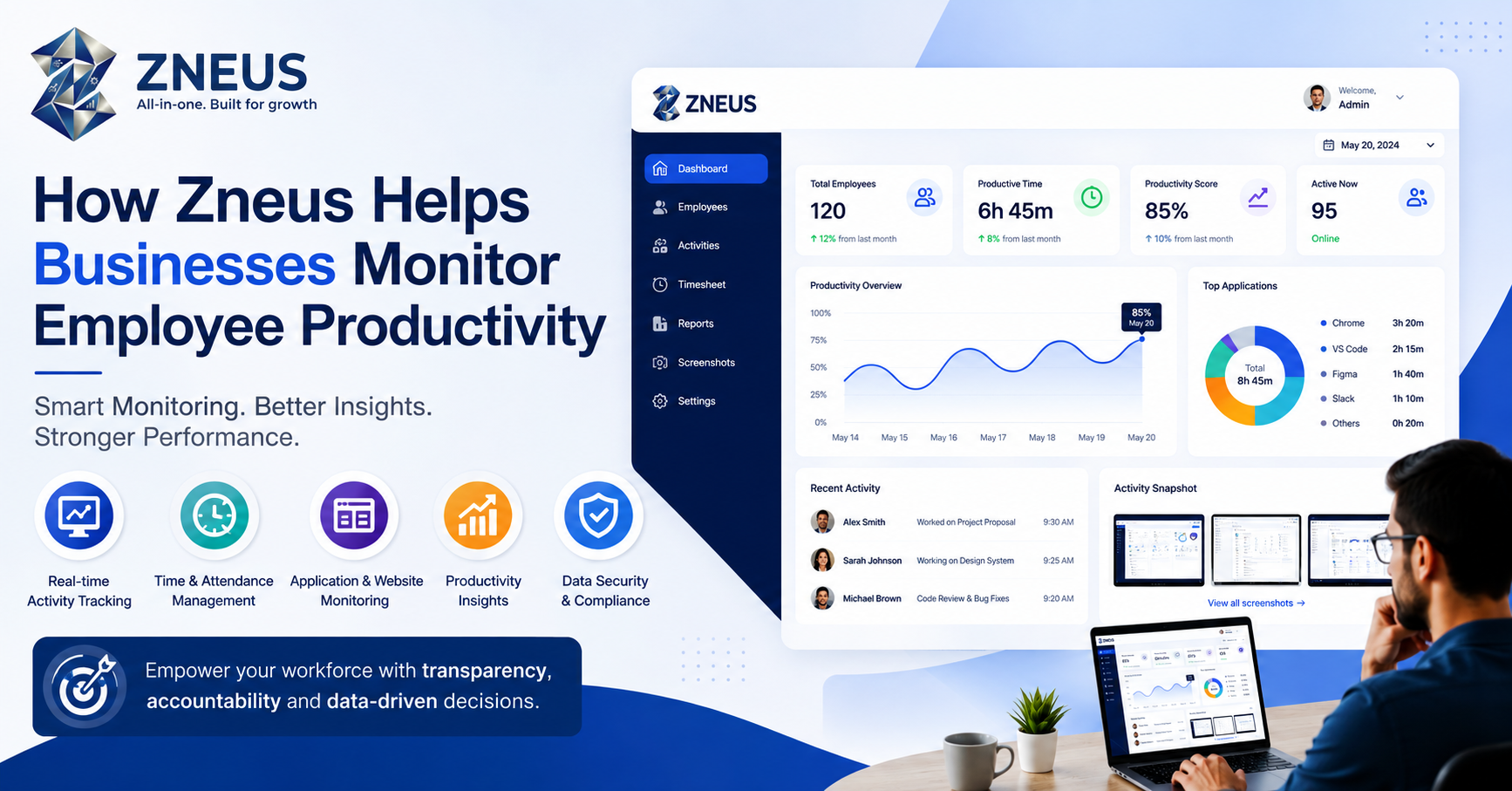
Zneus provides businesses with a centralized productivity dashboard where important workforce metrics can be viewed in one place.
A dashboard can help managers quickly understand key indicators such as:
- Total employees
- Productive time
- Productivity score
- Active employees
- Productivity trends
- Application usage
- Recent activities
Having these insights in one place makes it easier for managers to review workforce performance without going through multiple spreadsheets or manually collected reports.
6. Activity & Productivity Reports
Regular reporting is essential for understanding long-term employee productivity.
Zneus can help businesses analyze productivity information over time, allowing managers to identify trends and compare performance across different periods.
For example, managers can evaluate whether productivity is:
📈 Increasing — employees are becoming more efficient.
📊 Stable — performance is consistent.
📉 Declining — there may be workflow, workload, or engagement challenges that need attention.
These reports can support better workforce planning and performance management.
7. Identify Productivity Gaps
Every organization experiences productivity challenges from time to time. The important thing is identifying these challenges early.
Zneus helps businesses recognize unusual activity patterns, underutilized working hours, or areas where productivity may be lower than expected.
Once a productivity gap is identified, managers can investigate the underlying reason and provide appropriate support instead of simply assuming that an employee is underperforming.
8. Improve Team Performance
Productivity monitoring is not only about individual employees. It can also help organizations understand overall team performance.
Managers can use productivity insights to identify:
- High-performing teams
- Workflow bottlenecks
- Resource utilization
- Collaboration challenges
- Areas requiring additional support
This information can help businesses improve processes and create more efficient workflows across departments.
9. Data-Driven Decision Making
One of the biggest advantages of productivity monitoring is the ability to make decisions using real data.
Instead of relying completely on assumptions, managers can analyze actual productivity trends and workforce information.
For example, data can help organizations decide whether they need to:
- Improve existing workflows
- Reallocate resources
- Provide employee training
- Adjust workloads
- Improve time management
- Optimize workplace processes
This creates a more informed and strategic approach to workforce management.
10. Encourage Transparency & Accountability
Effective employee monitoring should be built around transparency and responsible use of data.
Zneus can help organizations create greater visibility into work processes while encouraging accountability across teams.
When employees understand what is being measured and why, productivity monitoring can become a tool for improvement rather than simply a surveillance mechanism.
The goal should be to empower employees, identify obstacles, and improve business performance.
How Zneus Supports Better Business Productivity
Zneus brings several productivity-focused capabilities together in one platform, helping businesses gain a broader understanding of their workforce.
Real-Time Activity Tracking
Understand employee activity and work patterns.
Time & Attendance Management
Track working hours and attendance efficiently.
Application & Website Monitoring
Understand how work-related applications and websites are being used.
Productivity Insights
Turn workforce activity data into useful productivity information.
Data Security & Compliance
Support responsible workforce monitoring with appropriate data protection practices.
Why Businesses Need Employee Productivity Monitoring
For modern businesses, productivity monitoring can provide valuable visibility into how time and resources are being utilized.
It can help organizations:
Improve Efficiency
Identify inefficient processes and optimize daily workflows.
Save Time
Reduce manual reporting and time-tracking tasks.
Increase Accountability
Create clearer visibility into work activities and responsibilities.
Identify Challenges
Recognize productivity issues and workflow bottlenecks earlier.
Make Better Decisions
Use real workforce data to support management decisions.
Improve Performance
Understand productivity trends and continuously improve business processes.